
IAE Academy

GATE 2024 BT Q.23: solution and answer

GATE 2024 · BTQ.23 · 1 mark · MCQ

Which one of the following is the basic principle of Sanger's DNA sequencing method?

  1. (A)

    Chain termination by incorporation of dideoxynucleotides

  2. (B)

    Chain elongation by incorporation of dideoxynucleotides

  3. (C)

    Release of inorganic pyrophosphate

  4. (D)

    Chain cleavage by modification of dideoxynucleotides
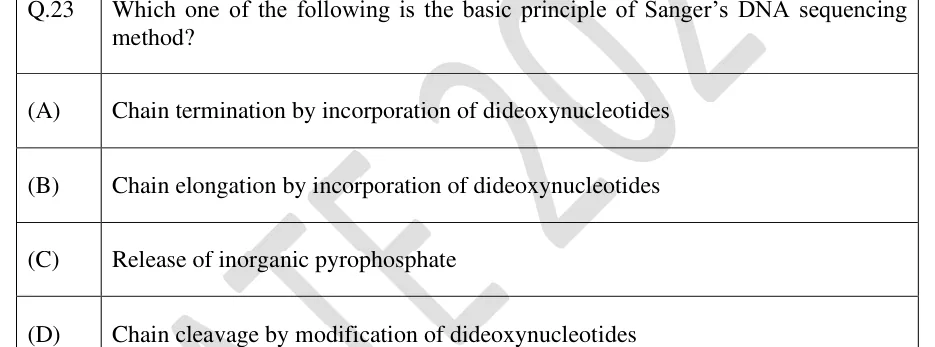
See the question in the paper

Answer and solution

ANSWER

(A): Sanger sequencing works by chain termination when a dideoxynucleotide is incorporated.

Official answer: ASource: Official answer key, GATE 2024 BT (IISc Bengaluru)

  1. Sanger's dideoxy chain-termination method uses a primer, template, DNA polymerase, normal dNTPs, and a small proportion of dideoxynucleotides (ddNTPs) in each reaction.

  2. A ddNTP lacks the 3'-OH group present on a normal deoxynucleotide, so once it is incorporated by the polymerase, no further phosphodiester bond can form — elongation of that particular strand stops at that position.

  3. Option (A) states exactly this mechanism — chain termination by incorporation of dideoxynucleotides — which is the defining principle of the method.

  4. Option (B) is incorrect: it labels the process 'chain elongation,' but the entire point of ddNTP incorporation is that it stops elongation, not continues it.

  5. Option (C) is incorrect: release of pyrophosphate (PPi) is a normal, generic step of every phosphodiester bond formation in DNA synthesis by any polymerase — it is not what distinguishes or explains the Sanger method.

  6. Option (D) is incorrect: the method involves no cleavage of the DNA chain and no chemical modification of ddNTPs; termination happens by incorporation and blocked extension, not by cutting.

  7. Random incorporation of ddNTPs across many copies of the template produces a nested set of fragments of every possible length, each ending at a ddNTP; separating these fragments by size reveals the sequence — confirming (A) as correct.

KEY IDEA

Sanger (dideoxy chain-termination) sequencing works by randomly incorporating 2',3'-dideoxynucleotides (ddNTPs), which lack the 3'-OH needed to form the next phosphodiester bond, so DNA synthesis terminates at that position — producing a nested set of fragments whose lengths, when separated, reveal the sequence.

WATCH OUT FOR

Confusing "chain elongation" (option B) with the correct mechanism; students sometimes forget that a ddNTP's missing 3'-OH group is what blocks further elongation, mistakenly thinking any nucleotide incorporation event described in an option could be the "principle," rather than recognizing termination specifically.

From the GATE 2024 BT paper. Every question of this paper · Download the full paper · All 8 PCR & sequencing questions, with notes

More PCR & sequencing questions