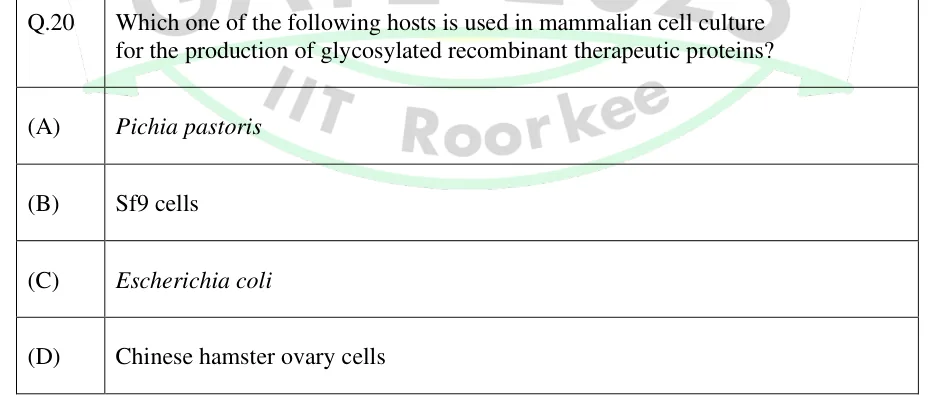
Which one of the following hosts is used in mammalian cell culture for the production of glycosylated recombinant therapeutic proteins?
- (A)
Pichia pastoris
- (B)
Sf9 cells
- (C)
Escherichia coli
- (D)
Chinese hamster ovary cells

Which one of the following hosts is used in mammalian cell culture for the production of glycosylated recombinant therapeutic proteins?
Pichia pastoris
Sf9 cells
Escherichia coli
Chinese hamster ovary cells
ANSWER
The correct answer is (D) Chinese hamster ovary (CHO) cells.
Official answer: DSource: Official answer key, GATE 2025 BT (IIT Roorkee)
The question requires a host that is BOTH (i) a mammalian cell culture system AND (ii) used to produce glycosylated recombinant therapeutic proteins — both conditions must hold.
(A) Pichia pastoris is a methylotrophic yeast (fungal), not a mammalian cell. It can glycosylate proteins, but with high-mannose, non-human-type glycans — excluded on the mammalian criterion.
(B) Sf9 cells are insect cells (from Spodoptera frugiperda), used in the baculovirus expression vector system — not mammalian, so excluded.
(C) Escherichia coli is a prokaryotic bacterium with no endoplasmic reticulum/Golgi apparatus, so it cannot glycosylate proteins at all and is not a mammalian (or even eukaryotic) culture system — excluded.
(D) Chinese hamster ovary (CHO) cells are a mammalian cell line and are the industry-standard host for producing glycosylated recombinant therapeutic proteins (e.g., monoclonal antibodies, EPO), because they carry out human-compatible N- and O-linked glycosylation and post-translational processing.
Only CHO cells satisfy both the mammalian-origin requirement and the correct-glycosylation requirement for a recombinant therapeutic protein, so the answer is (D).
KEY IDEA
CHO (Chinese hamster ovary) cells are the industry-standard mammalian host cell line for producing glycosylated recombinant therapeutic proteins (e.g., monoclonal antibodies, EPO) because they perform human-compatible N- and O-linked glycosylation and other post-translational modifications that non-mammalian systems cannot replicate.
WATCH OUT FOR
Confusing "can glycosylate proteins" with "is a mammalian host": Pichia pastoris (yeast) and Sf9 cells (insect, baculovirus system) both glycosylate proteins but produce non-human-type glycan patterns and are not mammalian cell lines, so they fail the question's explicit "mammalian cell culture" requirement even though they are valid non-mammalian expression hosts in other contexts.
From the GATE 2025 BT paper. Every question of this paper · Download the full paper · All 5 Libraries & cloning questions, with notes