IAE Academy

GATE 2020 BT Q.36: solution and answer

GATE 2020 · BTQ.36 · 2 marks · MCQ

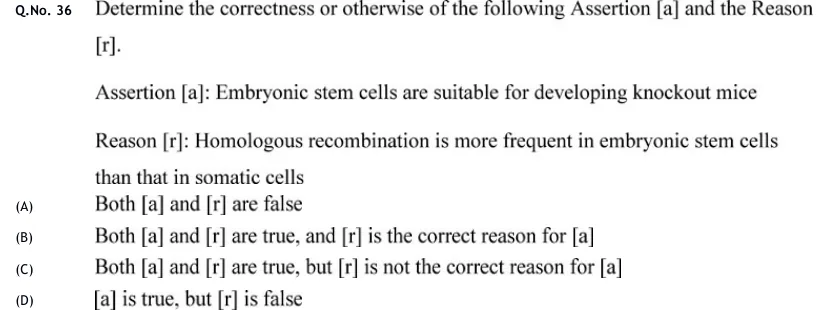
Determine the correctness or otherwise of the following Assertion [a] and the Reason [r].

Assertion [a]: Embryonic stem cells are suitable for developing knockout mice

Reason [r]: Homologous recombination is more frequent in embryonic stem cells than that in somatic cells

  1. (A)

    Both [a] and [r] are false

  2. (B)

    Both [a] and [r] are true, and [r] is the correct reason for [a]

  3. (C)

    Both [a] and [r] are true, but [r] is not the correct reason for [a]

  4. (D)

    [a] is true, but [r] is false

See the question in the paper

Answer and solution

ANSWER

Both [a] and [r] are true, and [r] is the correct reason for [a] — option (B).

Official answer: BSource: Official answer key, GATE 2020 BT (IIT Delhi)

  1. Assertion [a]: Embryonic stem (ES) cells are pluripotent, can be expanded and genetically modified in culture, clonally selected/screened for a correctly targeted allele, and then reintroduced into a host blastocyst to generate a chimeric mouse whose germline transmits the modification — this is exactly the standard route to a knockout mouse, so [a] is TRUE.

  2. Reason [r]: Gene targeting (the step that produces a knockout allele, as opposed to a random-insertion transgenic) works by homologous recombination between an introduced targeting vector and the endogenous locus.

  3. Homologous recombination occurs in essentially all mammalian cells, but at a very low frequency relative to non-homologous (random) integration. A distinguishing, well-documented property of mouse embryonic stem cells is that they support homologous recombination at a comparatively higher frequency than typical differentiated somatic cells, which is precisely why they can be used for targeted gene replacement in the first place; in ordinary somatic cells the targeting efficiency is impractically low. So [r] is TRUE.

  4. Because it is this higher relative homologous-recombination frequency (combined with the fact that only ES cells can later be returned to an embryo and contribute to the germline) that makes ES cells — and not somatic cells — the practical tool for producing a targeted knockout, [r] is not a coincidental true fact but the actual mechanistic reason underlying [a]. So [r] is the correct reason for [a].

  5. Eliminate (A) and (D): both [a] and [r] are true, not false.

  6. Eliminate (C): [r] is not merely an unrelated true statement — it directly explains why ES cells work for gene targeting as claimed in [a].

  7. Hence the correct choice is (B): both [a] and [r] are true, and [r] is the correct reason for [a].

KEY IDEA

Knockout mice are made by targeting a gene in embryonic stem (ES) cells via homologous recombination, then using the modified ES cells to generate germline-transmitting chimeras; ES cells are chosen for this because they support homologous recombination at a usefully higher relative frequency than ordinary somatic cells, and because only they can be returned to an embryo to contribute to the germline.

WATCH OUT FOR

Assuming [r] is a "true but irrelevant" statement (picking C) because homologous recombination sounds like a generic molecular fact unconnected to the assertion, without recognizing that this comparatively higher HR frequency in ES cells is exactly the mechanistic reason gene targeting for knockouts is feasible in this cell type.

From the GATE 2020 BT paper. Every question of this paper · Download the full paper · All 5 Libraries & cloning questions, with notes

More Libraries & cloning questions