IAE Academy

GATE 2026 BT Q.14: solution and answer

GATE 2026 · BTQ.14 · 1 mark · MCQ

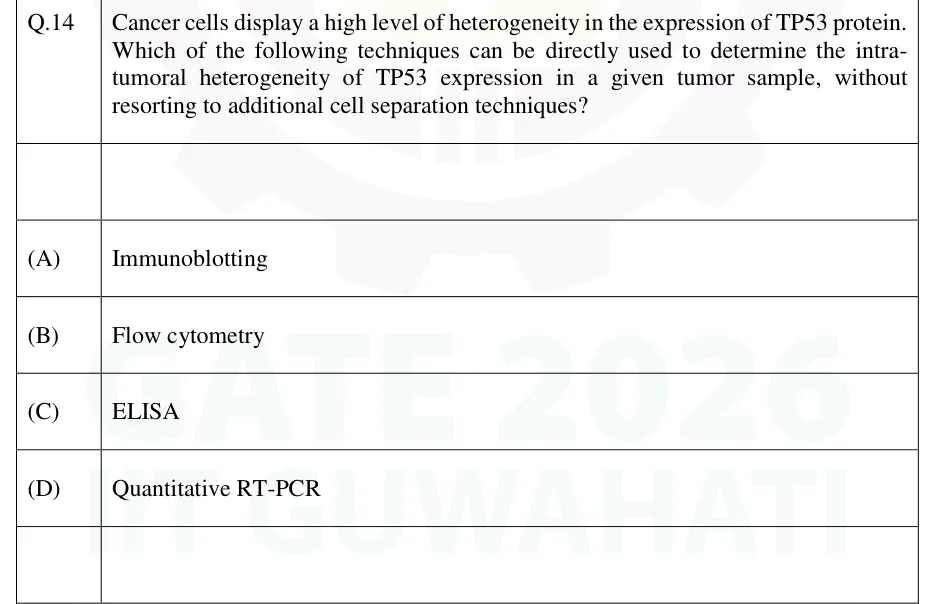
Cancer cells display a high level of heterogeneity in the expression of TP53 protein. Which of the following techniques can be directly used to determine the intra-tumoral heterogeneity of TP53 expression in a given tumor sample, without resorting to additional cell separation techniques?

  1. (A)

    Immunoblotting

  2. (B)

    Flow cytometry

  3. (C)

    ELISA

  4. (D)

    Quantitative RT-PCR

See the question in the paper

Answer and solution

ANSWER

The correct answer is (B) Flow cytometry.

Official answer: BSource: Official answer key, GATE 2026 BT (IIT Guwahati)

  1. Immunoblotting (A): the tumor sample is lysed and pooled before loading, so it reports a single averaged band intensity for the whole sample — heterogeneity between individual cells is lost. Not suitable.

  2. ELISA (C): also requires a homogenized/pooled lysate and reports one averaged absorbance/concentration value for the sample — cannot resolve cell-to-cell differences. Not suitable.

  3. Quantitative RT-PCR (D): measures average mRNA transcript abundance from bulk-extracted RNA — besides reading the wrong molecule (mRNA, not protein), it also yields a single pooled value rather than a per-cell readout. Not suitable.

  4. Flow cytometry (B): after fixation/permeabilization, cells are stained with a fluorescently labeled anti-TP53 antibody and passed one at a time past a laser detector, so each individual cell's TP53 signal is measured separately.

  5. This produces a distribution/histogram of TP53 expression across thousands of individual cells from the same tumor sample in a single run, directly revealing intra-tumoral heterogeneity.

  6. No prior physical cell separation (sorting into subpopulations, microdissection, etc.) is required — heterogeneity is read out for the whole mixed cell population simultaneously.

  7. Hence flow cytometry is the technique that can be directly used, satisfying the condition of not resorting to additional cell separation techniques.

KEY IDEA

Single-cell-resolved assays (flow cytometry) preserve heterogeneity information that bulk/pooled assays (immunoblotting, ELISA, qRT-PCR) inherently average away.

WATCH OUT FOR

Picking immunoblotting or ELISA because they are the standard protein-detection techniques for TP53, without noticing that both require a pooled/homogenized lysate and therefore report only an averaged, sample-level value — they cannot reveal cell-to-cell (intra-tumoral) heterogeneity.

From the GATE 2026 BT paper. Every question of this paper · Download the full paper · All 9 Assays & electrophoresis questions, with notes

More Assays & electrophoresis questions