IAE Academy

GATE 2025 BT Q.48: solution and answer

GATE 2025 · BTQ.48 · 2 marks · MCQ

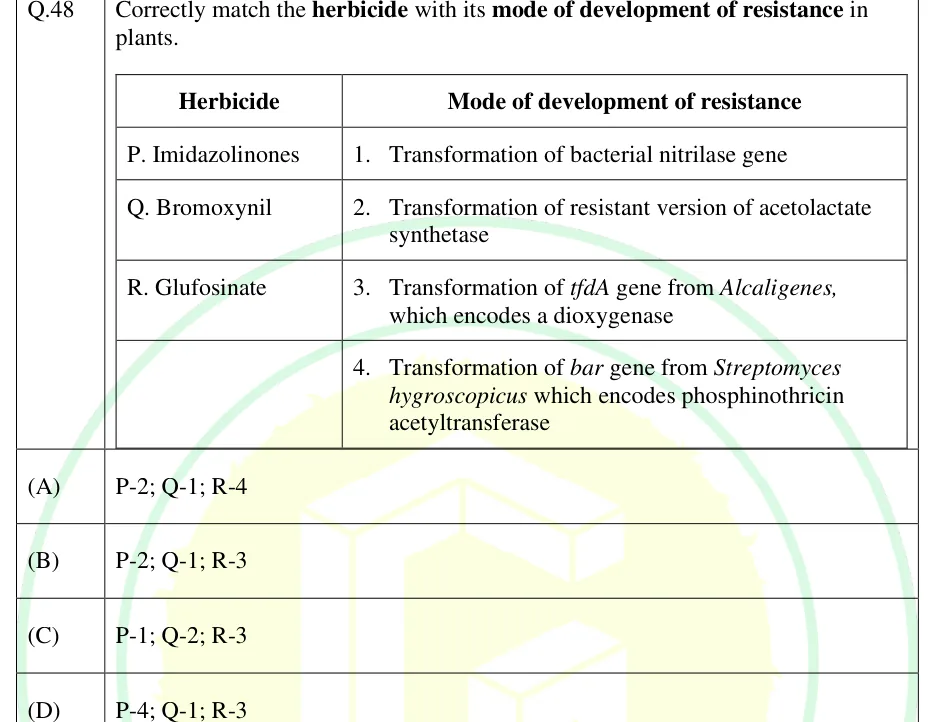
Correctly match the herbicide with its mode of development of resistance in plants. Herbicide: P. Imidazolinones; Q. Bromoxynil; R. Glufosinate. Mode of development of resistance: 1. Transformation of bacterial nitrilase gene; 2. Transformation of resistant version of acetolactate synthetase; 3. Transformation of tfdA gene from Alcaligenes, which encodes a dioxygenase; 4. Transformation of bar gene from Streptomyces hygroscopicus which encodes phosphinothricin acetyltransferase.

  1. (A)

    P-2; Q-1; R-4

  2. (B)

    P-2; Q-1; R-3

  3. (C)

    P-1; Q-2; R-3

  4. (D)

    P-4; Q-1; R-3

See the question in the paper

Answer and solution

ANSWER

The correct matching is P-2; Q-1; R-4, which is option (A).

Official answer: ASource: Official answer key, GATE 2025 BT (IIT Roorkee)

  1. Imidazolinones (such as imazapyr) inhibit acetolactate synthase (ALS), the first enzyme of branched-chain amino acid synthesis. Resistance is engineered by transforming a herbicide-insensitive version of ALS, so P matches 2.

  2. Bromoxynil is a nitrile herbicide that blocks photosystem II. A bacterial nitrilase hydrolyses its nitrile group to a non-toxic carboxylic acid, so transforming the bacterial nitrilase gene gives resistance. Q matches 1.

  3. Glufosinate (phosphinothricin) inhibits glutamine synthetase, so ammonia builds up and kills the plant. The bar gene from Streptomyces hygroscopicus encodes phosphinothricin acetyltransferase, which acetylates and inactivates the herbicide. R matches 4.

  4. The tfdA gene from Alcaligenes encodes a dioxygenase that degrades the auxin-mimic herbicide 2,4-D. No herbicide in the list is 2,4-D, so item 3 is the unused extra item. Options B and D both pair R with 3, so both are wrong.

  5. Option C pairs imidazolinones with the nitrilase gene (P-1) and bromoxynil with resistant ALS (Q-2), which is wrong. Only option A gives P-2, Q-1 and R-4.

KEY IDEA

Match each herbicide to its target or detoxifying enzyme. Imidazolinones target ALS, so the resistance gene is a resistant ALS. Bromoxynil is detoxified by bacterial nitrilase. Glufosinate is detoxified by the bar gene product, phosphinothricin acetyltransferase. The tfdA dioxygenase is the 2,4-D resistance route.

WATCH OUT FOR

Pairing glufosinate with tfdA, because both genes encode detoxifying enzymes. tfdA belongs to 2,4-D, which is not in the list. Another slip is to mix up the ALS-based and nitrilase-based routes for imidazolinones and bromoxynil.

From the GATE 2025 BT paper. Every question of this paper · Download the full paper · All 4 Transgenic plants questions, with notes

More Transgenic plants questions