
IAE Academy

ISRO CS 2023 Q.52: solution and answer

ISRO 2023 · CSQ.52 · 1 mark · MCQ

Match the Process Scheduler type with its Activity.

Process Scheduler type: (i) Long term scheduler; (ii) Medium term scheduler; (iii) Short Term Scheduler.
Activity: (P) executes much faster to reduce wastage of CPU time; (Q) controls degree of multiprogramming; (R) is associated with swapping.

With respect to Process Schedulers of an operating system mentioned above in the table, which of the following statements is correct?
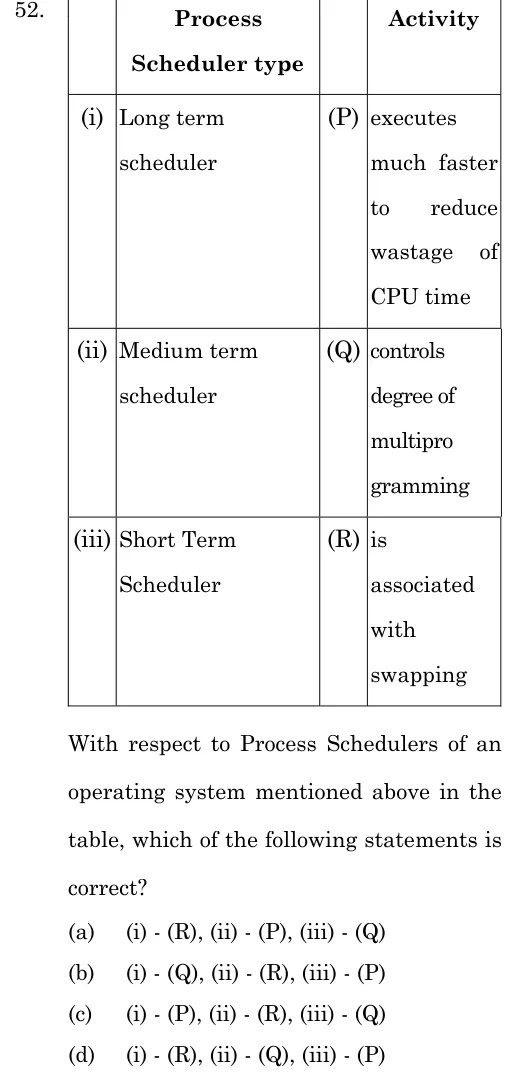
ISRO CS 2023 question 52: A table with two column pairs.Tap to open full size
Figure from the ISRO CS 2023 paper. It is part of the question.
Figure description

A table with two column pairs. The left pair lists the Process Scheduler type: (i) Long term scheduler, (ii) Medium term scheduler, (iii) Short Term Scheduler. The right pair lists the Activity: (P) executes much faster to reduce wastage of CPU time, (Q) controls degree of multiprogramming, (R) is associated with swapping. The rows are printed as i/P, ii/Q, iii/R; this row alignment is only the layout, not the correct matching.

  1. (A)

    (i) - (R), (ii) - (P), (iii) - (Q)

  2. (B)

    (i) - (Q), (ii) - (R), (iii) - (P)

  3. (C)

    (i) - (P), (ii) - (R), (iii) - (Q)

  4. (D)

    (i) - (R), (ii) - (Q), (iii) - (P)

Answer and solution

ANSWER

The correct matching is (i)-(Q), (ii)-(R), (iii)-(P), which is option (b).

Official answer: BSource: ISRO's revised and final answer key of 16 February 2024

  1. The long term (job) scheduler decides which jobs are admitted from the job pool into memory. It therefore sets how many processes are in memory at once, which is the degree of multiprogramming. So (i) matches (Q).

  2. The medium term scheduler swaps processes out of memory and later swaps them back in, which also lowers and restores the degree of multiprogramming. So (ii) matches (R), swapping.

  3. The short term (CPU) scheduler picks the next ready process to run and is invoked very often, so it must be very fast so that little CPU time is wasted on scheduling. So (iii) matches (P).

  4. The matching is (i)-(Q), (ii)-(R), (iii)-(P), which is option (b). Options (a) and (d) give swapping or the speed requirement to the long term scheduler. Option (c) gives the long term scheduler the speed requirement and the short term scheduler control of multiprogramming.

KEY IDEA

Long term scheduler: admits jobs and so controls the degree of multiprogramming. Medium term scheduler: swaps processes in and out. Short term scheduler: runs most often, so it must be the fastest.

WATCH OUT FOR

Reading the table rows as the matching, i.e. (i)-(P), (ii)-(Q), (iii)-(R). The letters printed beside each scheduler are only the table layout. Another slip is attaching swapping to the long term scheduler instead of the medium term one.

From the ISRO CS 2023 paper. Every question of this paper · The full paper (PDF, ISRO) · All 3 ISRO CPU scheduling questions, with notes

More ISRO CPU scheduling questions