
IAE Academy

GATE 2026 IN Q.49: solution and answer

GATE 2026 · INQ.49 · 2 marks · MCQ

If the definition of SI unit 'X' is required to define SI unit 'Y', the dependency is indicated as X → Y. A valid order of dependencies, as per present convention, is ____________.

  1. (A)

    metre → second → kilogram → kelvin

  2. (B)

    second → metre → kilogram → kelvin

  3. (C)

    metre → second → kelvin → kilogram

  4. (D)

    second → kilogram → kelvin → metre
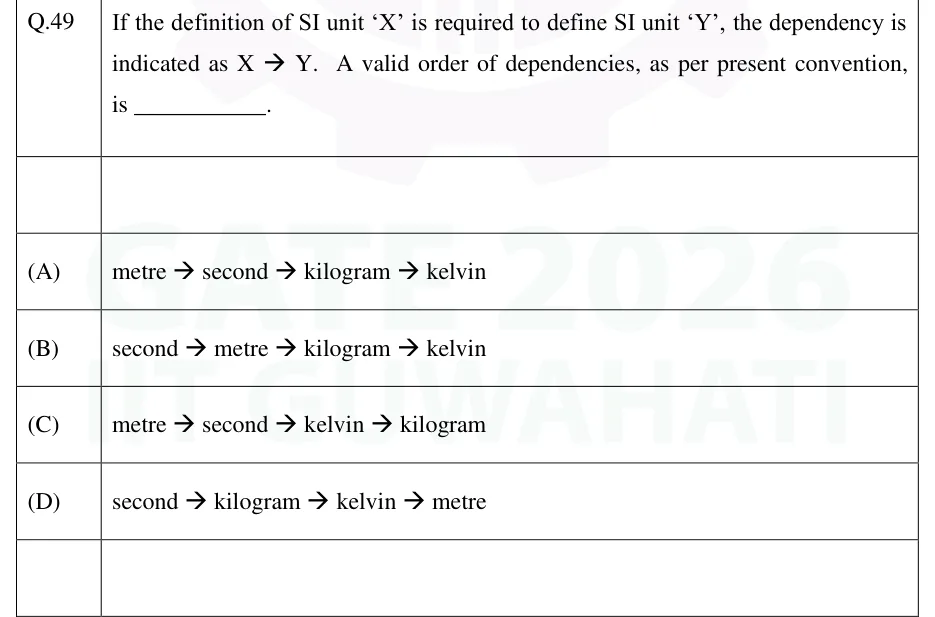
See the question in the paper

Answer and solution

ANSWER

(B) second → metre → kilogram → kelvin. In the 2019 SI the second is fixed by the caesium frequency, the metre by (which needs the second), the kilogram by (which needs the metre and the second) and the kelvin by (which needs the kilogram through the joule).

Official answer: BSource: Official answer key, GATE 2026 IN (IIT Guwahati)

  1. In the present SI (revised in 2019), each base unit is defined by fixing the numerical value of a defining constant. A unit depends on every other base unit that appears in the SI unit of its constant. So an arrow is valid only if unit appears in the unit of the constant that defines .

  2. Second: fixed by the caesium-133 hyperfine transition frequency, , where . No other base unit is needed, so the second comes first.

  3. Metre: fixed by the speed of light in vacuum, . The second is needed, so .

  4. Kilogram: fixed by the Planck constant, , where . Both the metre and the second are needed, so .

  5. Kelvin: fixed by the Boltzmann constant, , where . It needs the kilogram, the metre and the second, so .

  6. Every arrow in the chain is therefore a genuine dependency:

  7. Checking the other options arrow by arrow: (A) and (C) both begin with , but the second is defined by alone and does not need the metre (it is the other way round). (C) also has , but contains no kelvin, so the kilogram does not need the kelvin. (D) ends with , but contains no kelvin, so the metre does not need it; in fact the kelvin needs the metre. The answer is (B).

KEY IDEA

In the 2019 SI each base unit is defined by fixing an exact value of a constant: (second), (metre), (kilogram) and (kelvin). To see what a unit depends on, write the constant's unit in base units: , , , . The dependencies line up as second → metre → kilogram → kelvin.

WATCH OUT FOR

Going by the old definitions or the usual listing order (metre, kilogram, second, ...) and putting the metre before the second. Since 1983 the metre has been defined through the second, and the kilogram is no longer a platinum-iridium artefact: since 2019 it is defined through , which brings in the metre and the second. A second trap is thinking the kelvin is independent (the old triple-point-of-water definition). Because is in , the kelvin now depends on the kilogram, metre and second.

From the GATE 2026 IN paper. Every question of this paper · Download the full paper · All 11 Errors & standards questions, with notes

More Errors & standards questions