IAE Academy

GATE 2020 BT Q.31: solution and answer

GATE 2020 · BTQ.31 · 2 marks · MCQ

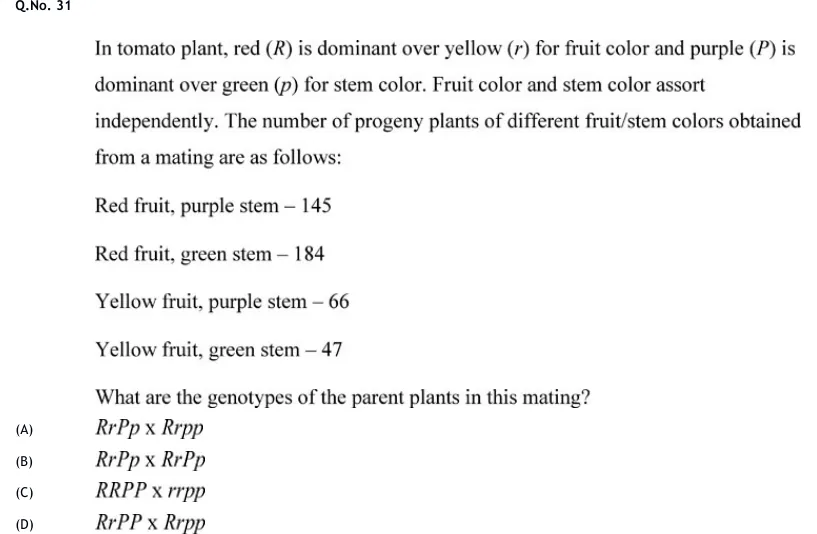
In tomato plant, red (R) is dominant over yellow (r) for fruit color and purple (P) is dominant over green (p) for stem color. Fruit color and stem color assort independently. The number of progeny plants of different fruit/stem colors obtained from a mating are as follows:
Red fruit, purple stem – 145
Red fruit, green stem – 184
Yellow fruit, purple stem – 66
Yellow fruit, green stem – 47
What are the genotypes of the parent plants in this mating?

  1. (A)

    RrPp x Rrpp

  2. (B)

    RrPp x RrPp

  3. (C)

    RRPP x rrpp

  4. (D)

    RrPP x Rrpp

See the question in the paper

Answer and solution

ANSWER

The parental genotypes are RrPp × Rrpp (Option A).

Official answer: ASource: Official answer key, GATE 2020 BT (IIT Delhi)

  1. Total progeny = 145 + 184 + 66 + 47 = 442.

  2. Group by fruit color alone: Red (145+184 = 329) : Yellow (66+47 = 113) ≈ 2.91:1, i.e. a 3:1 ratio. A single-gene 3:1 ratio arises from a cross of two heterozygotes at that locus: Rr x Rr → 3/4 R_ : 1/4 rr.

  3. Group by stem color alone: Purple (145+66 = 211) : Green (184+47 = 231) ≈ 0.91:1, i.e. a 1:1 ratio. A single-gene 1:1 ratio is the classic test-cross ratio, arising from heterozygote x homozygous recessive: Pp x pp → 1/2 Pp : 1/2 pp (one parent contributes only the recessive p gamete).

  4. Since fruit color and stem color assort independently, the expected joint phenotypic ratio is the product of the two single-trait ratios: (3:1) x (1:1) = 3:3:1:1 for Red-Purple : Red-Green : Yellow-Purple : Yellow-Green.

  5. Check Option A, RrPp x Rrpp: Rr x Rr gives 3/4 R_ : 1/4 rr; Pp x pp gives 1/2 Pp : 1/2 pp. Combined: R_Pp = 3/8, R_pp = 3/8, rrPp = 1/8, rrpp = 1/8, i.e. 3:3:1:1 — matching the 3:1 fruit-color split and 1:1 stem-color split derived from the data.

  6. Rule out Option B (RrPp x RrPp): this is a genuine dihybrid cross giving 9:3:3:1, which requires BOTH fruit color and stem color to each split 3:1. Stem color here splits 1:1, not 3:1 — rejected.

  7. Rule out Option C (RRPP x rrpp): a cross between two true-breeding homozygotes gives 100% RrPp (all red, all purple) progeny with no segregation at all — contradicts the four observed phenotype classes — rejected.

  8. Rule out Option D (RrPP x Rrpp): PP x pp gives all Pp progeny (100% purple stem, no green-stemmed progeny), but green-stemmed plants (184+47 = 231) are clearly present — rejected.

  9. Therefore the parental genotypes that produce a 3:1 fruit-color split and a 1:1 stem-color split are RrPp (heterozygous at both loci) x Rrpp (heterozygous for fruit color, homozygous recessive for stem color) — Option A.

KEY IDEA

When two independently assorting traits are involved, decompose the progeny into single-trait totals first; the ratio each trait shows on its own (3:1, 1:1, etc.) tells you the cross type at that one locus, and the product of the two single-trait ratios must equal the observed four-class ratio.

WATCH OUT FOR

Jumping straight to a 9:3:3:1 dihybrid expectation (as in Option B) without first checking that BOTH traits individually segregate 3:1 — here the stem-color trait alone is 1:1 (a test cross, Pp × pp), not 3:1, which rules out a heterozygote × heterozygote cross at that locus.

From the GATE 2020 BT paper. Every question of this paper · Download the full paper · All 10 Mendelian genetics questions, with notes

More Mendelian genetics questions