
IAE Academy

GATE 2020 BT Q.30: solution and answer

GATE 2020 · BTQ.30 · 2 marks · MCQ

W, X and Y are the intermediates in a biochemical pathway as shown below:

S ⋯⋯> W → X → Y → Z

Mutants auxotrophic for Z are found in four different complementation groups, namely Z1, Z2, Z3 and Z4. The growth of these mutants on media supplemented with W, X, Y or Z is shown below (Yes: growth observed; No: growth not observed):

Mutants | W | X | Y | Z
Z1 | No | No | Yes | Yes
Z2 | No | Yes | Yes | Yes
Z3 | No | No | No | Yes
Z4 | Yes | Yes | Yes | Yes

What is the order of the four complementation groups in terms of the step they block?
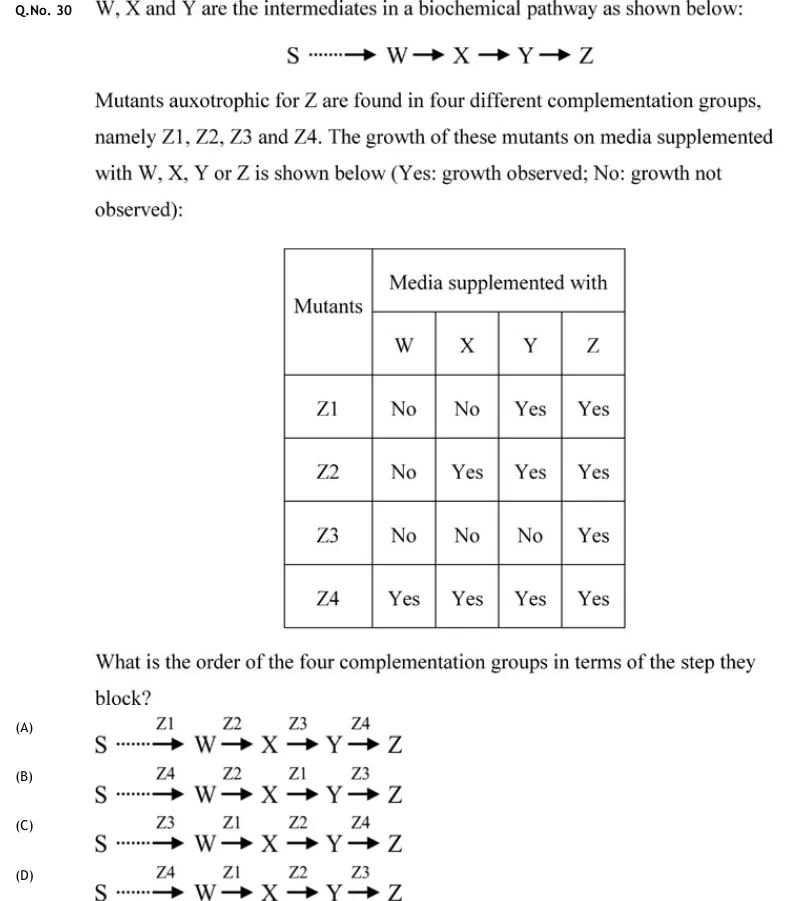
GATE 2020 BT question 30: A pathway diagram: S connected by a dashed arrow to W, then solid arrows W→X→Y→Z.Tap to open full size
Figure from the GATE 2020 BT paper. It is part of the question.
Figure description

A pathway diagram: S connected by a dashed arrow to W, then solid arrows W→X→Y→Z. Below it, a 4-row x 4-column data table listing growth (Yes/No) of mutants Z1–Z4 on media supplemented with W, X, Y, or Z respectively (as given in the stem). The four options (A–D) each redraw the same pathway S ⋯> W → X → Y → Z with the four mutant labels (in some order of Z1–Z4) placed above the four arrows, indicating which mutant blocks which step: (A) Z1, Z2, Z3, Z4 in that order over the four arrows; (B) Z4, Z2, Z1, Z3; (C) Z3, Z1, Z2, Z4; (D) Z4, Z1, Z2, Z3.

  1. (A)

    S ⋯(Z1)⋯> W —(Z2)→ X —(Z3)→ Y —(Z4)→ Z

  2. (B)

    S ⋯(Z4)⋯> W —(Z2)→ X —(Z1)→ Y —(Z3)→ Z

  3. (C)

    S ⋯(Z3)⋯> W —(Z1)→ X —(Z2)→ Y —(Z4)→ Z

  4. (D)

    S ⋯(Z4)⋯> W —(Z1)→ X —(Z2)→ Y —(Z3)→ Z

Answer and solution

ANSWER

The order of complementation groups along the pathway S → W → X → Y → Z is Z4, Z2, Z1, Z3, which is option (B).

Official answer: BSource: Official answer key, GATE 2020 BT (IIT Delhi)

  1. Rule: a mutant blocked at a given step is rescued (grows) when supplied with the product of that step or any intermediate further downstream, but not by anything upstream of its own block (it already synthesizes everything upstream itself).

  2. Four possible block positions along S → W → X → Y → Z: (i) S→W, (ii) W→X, (iii) X→Y, (iv) Y→Z.

  3. Block (i) S→W: rescued by W, X, Y, Z → pattern (Yes, Yes, Yes, Yes).

  4. Block (ii) W→X: rescued by X, Y, Z but not W → pattern (No, Yes, Yes, Yes).

  5. Block (iii) X→Y: rescued by Y, Z but not W, X → pattern (No, No, Yes, Yes).

  6. Block (iv) Y→Z: rescued only by Z (the final product) → pattern (No, No, No, Yes).

  7. Match against the table: Z4 (Yes,Yes,Yes,Yes) = block (i) S→W; Z2 (No,Yes,Yes,Yes) = block (ii) W→X; Z1 (No,No,Yes,Yes) = block (iii) X→Y; Z3 (No,No,No,Yes) = block (iv) Y→Z.

  8. Assembling along the pathway: S —Z4→ W —Z2→ X —Z1→ Y —Z3→ Z, i.e., order Z4, Z2, Z1, Z3.

  9. This matches option (B).

KEY IDEA

A biosynthetic-pathway mutant blocked at a given step can grow only if supplied with the product of that step or any later intermediate (it can still make everything upstream itself); it cannot use anything upstream of its own block. Map each mutant's Yes/No growth pattern to a block position accordingly, then read off the pathway order.

WATCH OUT FOR

Reversing the growth-rescue logic — assuming a mutant is rescued by intermediates upstream of its block (since it can still "process" earlier steps) rather than by the blocked step's product and everything downstream. This flips the mapping and can make Z1 look like the earliest block instead of Z4.

From the GATE 2020 BT paper. Every question of this paper · Download the full paper · All 10 Mendelian genetics questions, with notes

More Mendelian genetics questions