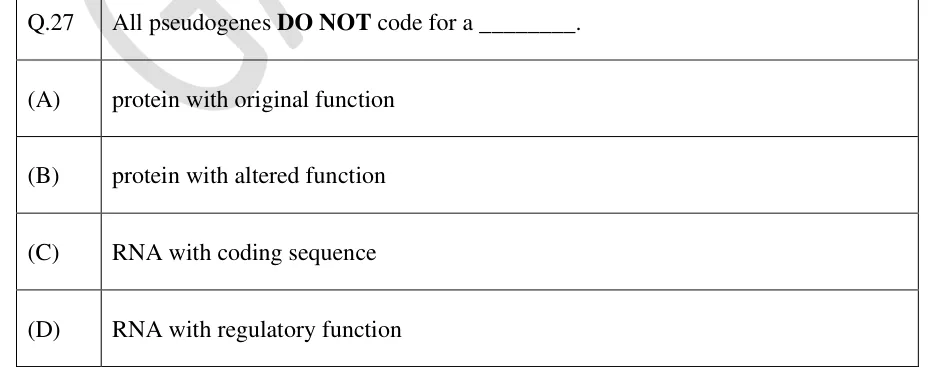
All pseudogenes DO NOT code for a ________.
- (A)
protein with original function
- (B)
protein with altered function
- (C)
RNA with coding sequence
- (D)
RNA with regulatory function

All pseudogenes DO NOT code for a ________.
protein with original function
protein with altered function
RNA with coding sequence
RNA with regulatory function
ANSWER
Q.27 (GATE BT 2024, 1 mark, MCQ): "All pseudogenes DO NOT code for a ________." Options: (A) protein with original function; (B) protein with altered function; (C) RNA with coding sequence; (D) RNA with regulatory function. Official answer: (A).
Official answer: ASource: Official answer key, GATE 2024 BT (IISc Bengaluru)
A pseudogene is defined as a gene copy (from duplication or retrotransposition) that has lost the ability to produce the ancestral gene's original, functional protein — through disabling mutations, premature stop codons, frameshifts, or loss of essential regulatory/promoter elements.
Check (A) 'protein with original function': by this very definition, NO pseudogene, of any class, can produce the ancestral protein's original function — this is the one property universally absent in every pseudogene.
Check (B) 'protein with altered function': some pseudogenes retain enough of an intact reading frame to be translated into a truncated or altered-function protein (rare 'pseudogene resurrection'/exaptation cases), so this is not excluded in ALL pseudogenes.
Check (C) 'RNA with coding sequence': many pseudogenes, particularly unprocessed/duplicated ones, are transcribed and their RNA retains an intact coding sequence even when not translated into a functional protein — so this too is not universally excluded.
Check (D) 'RNA with regulatory function': several pseudogenes are transcribed into long non-coding RNAs or antisense RNAs that regulate expression of their parent gene (a documented exception), so this is also not universally excluded.
Only option (A) — loss of the original functional protein — is true for every pseudogene without exception, so (A) is the correct answer.
KEY IDEA
A pseudogene is, by definition, a gene copy (arising from duplication or retrotransposition) that has lost the ability to produce the ancestral gene's original, functional protein through mutations, premature stop codons, frameshifts, or loss of essential regulatory elements — this loss of original protein-coding capacity is the one property that is true of every pseudogene without exception, unlike the other listed outcomes (altered-function proteins from rare intact ORFs, retained coding-like RNA sequence, or regulatory/antisense ncRNA roles), each of which is documented in only a subset of pseudogenes.
WATCH OUT FOR
Assuming "pseudogene" means "produces no RNA or protein product at all," and therefore picking an option about RNA (C or D) as the "impossible" one — when in fact many pseudogenes are actively transcribed (some even translated into truncated/altered products or functioning as regulatory ncRNAs); the only property universal to ALL pseudogenes is the definitional loss of the capacity to yield the original, functional protein.
From the GATE 2024 BT paper. Every question of this paper · Download the full paper · All 9 Mutation & repair questions, with notes