
IAE Academy

GATE 2023 BT Q.15: solution and answer

GATE 2023 · BTQ.15 · 1 mark · MCQ

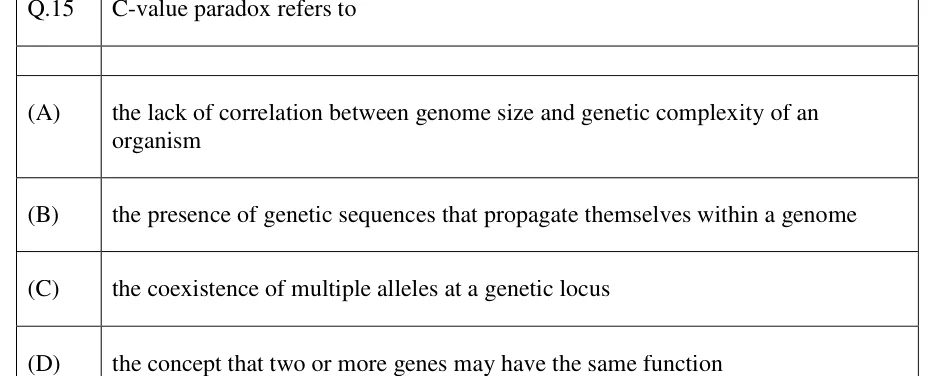
C-value paradox refers to

  1. (A)

    the lack of correlation between genome size and genetic complexity of an organism

  2. (B)

    the presence of genetic sequences that propagate themselves within a genome

  3. (C)

    the coexistence of multiple alleles at a genetic locus

  4. (D)

    the concept that two or more genes may have the same function
See the question in the paper

Answer and solution

ANSWER

(A): the C-value paradox is the lack of correlation between genome size and the genetic complexity of an organism.

Official answer: ASource: Official answer key, GATE 2023 BT (IIT Kanpur)

  1. Recall the definition of "C-value": the amount of haploid DNA (genome size) contained in a cell of an organism.

  2. The C-value paradox is the well-documented observation that genome size (C-value) does not correlate with the organism's morphological or genetic complexity — for example, some amoebae and lungfish have genomes far larger than the human genome despite not being more "complex," a discrepancy largely attributable to variable amounts of non-coding/repetitive DNA.

  3. Option (A) states precisely this — lack of correlation between genome size and genetic complexity — so (A) is correct.

  4. Option (B) describes the behaviour of selfish/transposable genetic elements, which is a proposed contributor to genome size expansion but is not itself the definition of the C-value paradox — incorrect.

  5. Option (C) describes the coexistence of multiple alleles at a locus, a population-genetics concept (related to heterozygosity), unrelated to genome size — incorrect.

  6. Option (D) describes functional redundancy among genes, unrelated to genome size or the paradox — incorrect.

  7. Hence only (A) correctly defines the C-value paradox.

KEY IDEA

The C-value paradox: an organism's haploid genome size (its C-value) does not correlate with its morphological or organismal complexity — e.g., some amoebae, lungfish, and even some plants have vastly larger genomes than humans, largely due to variable amounts of non-coding/repetitive DNA rather than a greater number of functional genes.

WATCH OUT FOR

Confusing the C-value paradox (genome size vs. complexity mismatch) with related but distinct concepts also tested as distractors: transposable/selfish DNA propagation (a proposed cause of genome size variation, not the paradox itself), multiple alleles at a locus (a population-genetics idea unrelated to genome size), or gene functional redundancy (unrelated to genome size).

From the GATE 2023 BT paper. Every question of this paper · Download the full paper · All 9 Mutation & repair questions, with notes

More Mutation & repair questions