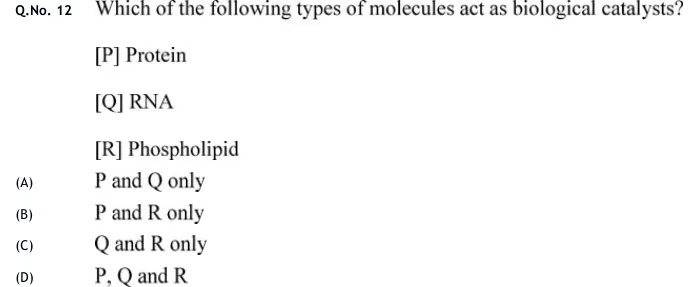
Which of the following types of molecules act as biological catalysts?
[P] Protein
[Q] RNA
[R] Phospholipid
- (A)
P and Q only
- (B)
P and R only
- (C)
Q and R only
- (D)
P, Q and R

Which of the following types of molecules act as biological catalysts?
[P] Protein
[Q] RNA
[R] Phospholipid
P and Q only
P and R only
Q and R only
P, Q and R
ANSWER
Option (A): P and Q only.
Official answer: ASource: Official answer key, GATE 2020 BT (IIT Delhi)
A biological catalyst speeds up a reaction by lowering its activation energy and is not consumed. The question asks which of the three molecule classes do this.
[P] Protein: most enzymes are proteins, so proteins act as biological catalysts.
[Q] RNA: catalytic RNAs (ribozymes) exist. Examples are the peptidyl transferase activity of ribosomal RNA, RNase P and self-splicing group I and group II introns. So RNA is also a biological catalyst.
[R] Phospholipid: phospholipids form membrane bilayers and act as precursors for signalling molecules, but they have no catalytic activity of their own. So R is not a biological catalyst.
The catalysts are P and Q only, which is option (A). Options (B), (C) and (D) each include phospholipid and are wrong.
KEY IDEA
Enzymes are not all proteins. Ribozymes show that RNA can also catalyse reactions. Lipids such as phospholipids are structural and signalling molecules, not catalysts.
WATCH OUT FOR
Answering "protein only" because enzymes are usually taught as proteins, and so missing that RNA (ribozymes) also catalyses reactions. Some candidates also add phospholipid because they confuse its role in membranes and signalling with catalysis.
From the GATE 2020 BT paper. Every question of this paper · Download the full paper · All 6 Enzymes questions, with notes