
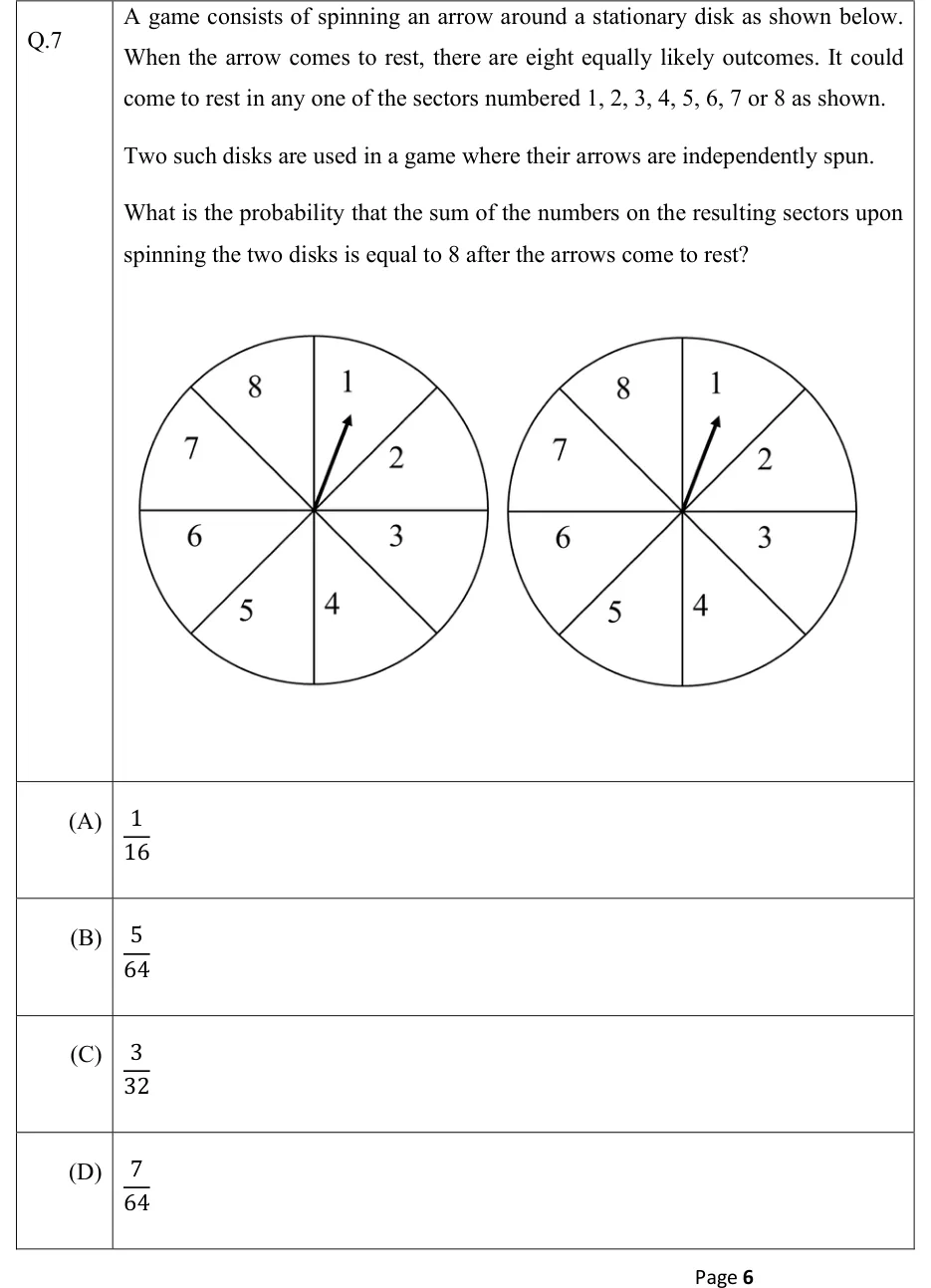
A game consists of spinning an arrow around a stationary disk as shown below. When the arrow comes to rest, there are eight equally likely outcomes. It could come to rest in any one of the sectors numbered 1, 2, 3, 4, 5, 6, 7 or 8 as shown.
Two such disks are used in a game where their arrows are independently spun.
What is the probability that the sum of the numbers on the resulting sectors upon spinning the two disks is equal to 8 after the arrows come to rest?
 Tap to open full size
Figure description
Two identical circular disks drawn side by side. Each circle is divided into 8 equal sectors (45 degrees each) by four straight lines through the centre: one vertical, one horizontal and two diagonals at 45 degrees. The sectors are numbered clockwise starting just right of the top of the vertical line: 1 (top, between the vertical line and the upper-right diagonal), 2 (between the upper-right diagonal and the horizontal line, right side), 3 (between the horizontal line and the lower-right diagonal), 4 (between the lower-right diagonal and the bottom of the vertical line), 5 (between the bottom of the vertical line and the lower-left diagonal), 6 (between the lower-left diagonal and the horizontal line, left side), 7 (between the horizontal line and the upper-left diagonal), 8 (between the upper-left diagonal and the top of the vertical line). In each disk a single arrow starts at the centre and points up and slightly to the right, into sector 1. No shading.
- (A)
- (B)
- (C)
- (D)