IAE Academy

GATE 2023 IN GA Q.8: solution and answer

GATE 2023 · INGA Q.8 · 2 marks · MCQ

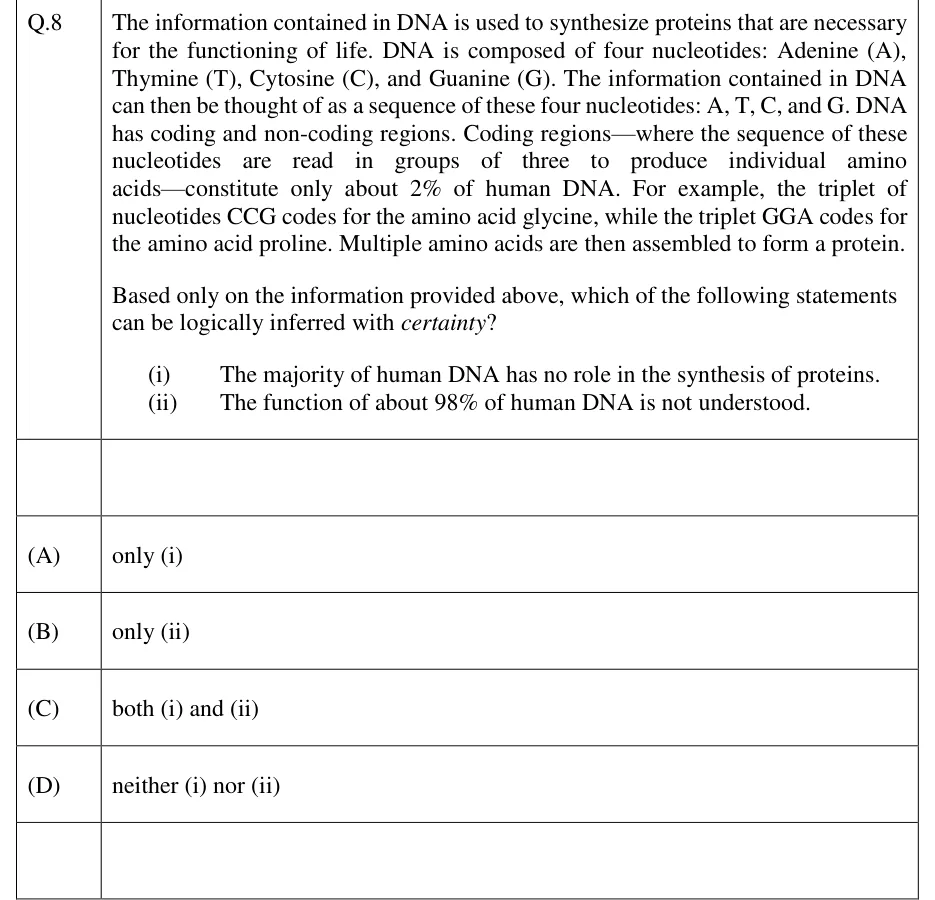
The information contained in DNA is used to synthesize proteins that are necessary for the functioning of life. DNA is composed of four nucleotides: Adenine (A), Thymine (T), Cytosine (C), and Guanine (G). The information contained in DNA can then be thought of as a sequence of these four nucleotides: A, T, C, and G. DNA has coding and non-coding regions. Coding regions—where the sequence of these nucleotides are read in groups of three to produce individual amino acids—constitute only about 2% of human DNA. For example, the triplet of nucleotides CCG codes for the amino acid glycine, while the triplet GGA codes for the amino acid proline. Multiple amino acids are then assembled to form a protein.

Based only on the information provided above, which of the following statements can be logically inferred with certainty?

(i) The majority of human DNA has no role in the synthesis of proteins.

(ii) The function of about 98% of human DNA is not understood.

  1. (A)

    only (i)

  2. (B)

    only (ii)

  3. (C)

    both (i) and (ii)

  4. (D)

    neither (i) nor (ii)

See the question in the paper

Answer and solution

ANSWER

(D) neither (i) nor (ii). The passage says only that about 2% of human DNA is coding, meaning it is read in triplets to produce amino acids. It says nothing about whether the other 98% has a role in protein synthesis, or about how well that 98% is understood.

Official answer: DSource: Official answer key, GATE 2023 IN (IIT Kanpur)

  1. What 'inferred with certainty' asks for. A statement qualifies only if the passage forces it to be true. Outside knowledge does not count, and neither does a statement that is merely likely.

  2. What the passage actually says. DNA has coding and non-coding regions. Coding regions, where the nucleotides are read in groups of three to produce individual amino acids, make up only about 2% of human DNA. So about 98% is non-coding, meaning it is not read in triplets to produce amino acids.

  3. Test (i): "The majority of human DNA has no role in the synthesis of proteins." The passage defines only what the coding part does, which is to be read in triplets to produce amino acids. It never says what the non-coding part does. In particular, it never says the non-coding part has no role in protein synthesis. That part could still help in some other way (for example, by affecting when or how much protein is made), and nothing in the passage rules this out.

  4. So 'not read into amino acids' does not force 'no role in synthesis'. (i) may be true, but the passage does not make it certain. (i) cannot be inferred.

  5. Test (ii): "The function of about 98% of human DNA is not understood." The passage says nothing about how much is known or understood about any part of DNA. 'Non-coding' describes what a region does not do. It says nothing about the state of scientific knowledge.

  6. (ii) brings in a new idea, understanding, that the passage never mentions. (ii) cannot be inferred either.

  7. Neither statement follows with certainty from the passage, so the answer is (D) neither (i) nor (ii).

KEY IDEA

An inference 'with certainty' must be forced by the passage alone. Being 'non-coding' (not read in triplets into amino acids) is a narrower claim than having 'no role in protein synthesis', and it says nothing at all about whether a region's function is 'understood'.

WATCH OUT FOR

Picking (A): reading 'only about 2% is coding' as 'the other 98% has no role in making proteins'. The passage says only that the 98% is not read into amino acids, not that it plays no part. Picking (B) or (C) is also a mistake, because it brings in the familiar outside idea that non-coding DNA is poorly understood, which the passage never states. Answer from the passage alone, not from what you already know about biology.

From the GATE 2023 IN paper. Every question of this paper · Download the full paper · All 18 Reading questions, with notes

More Reading questions