
IAE Academy

GATE 2022 EC GA Q.6: solution and answer

GATE 2022 · ECGA Q.6 · 2 marks · MCQ

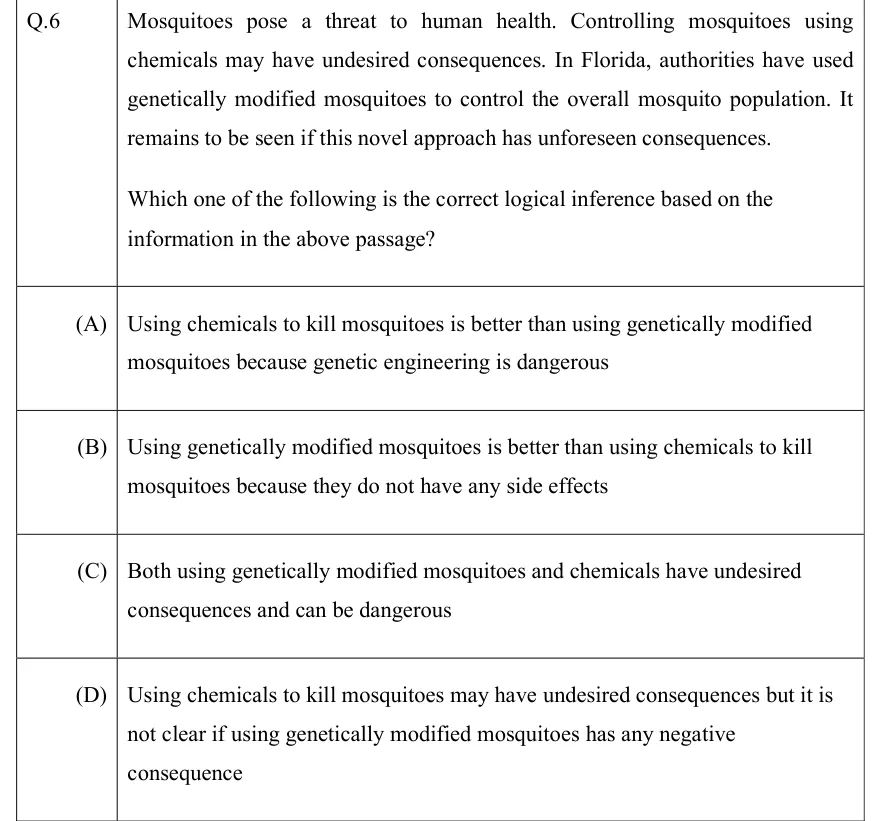
Mosquitoes pose a threat to human health. Controlling mosquitoes using chemicals may have undesired consequences. In Florida, authorities have used genetically modified mosquitoes to control the overall mosquito population. It remains to be seen if this novel approach has unforeseen consequences.

Which one of the following is the correct logical inference based on the information in the above passage?

  1. (A)

    Using chemicals to kill mosquitoes is better than using genetically modified mosquitoes because genetic engineering is dangerous

  2. (B)

    Using genetically modified mosquitoes is better than using chemicals to kill mosquitoes because they do not have any side effects

  3. (C)

    Both using genetically modified mosquitoes and chemicals have undesired consequences and can be dangerous

  4. (D)

    Using chemicals to kill mosquitoes may have undesired consequences but it is not clear if using genetically modified mosquitoes has any negative consequence
See the question in the paper

Answer and solution

ANSWER

The correct option is (D). It is the only one that keeps the passage's \"may\" about chemicals and its \"remains to be seen\" about GM mosquitoes, and it adds no comparison or certainty of its own.

Official answer: DSource: Official answer key, GATE 2022 EC (IIT Kharagpur)

  1. Pick out what the passage actually claims. (1) Controlling mosquitoes with chemicals may have undesired consequences. (2) Florida has used genetically modified (GM) mosquitoes to control the mosquito population. (3) "It remains to be seen" whether the GM approach has unforeseen consequences, so its effects are not yet known.

  2. The rule for a valid inference: it must follow from the passage alone. It cannot add a comparison or a certainty that the passage does not state.

  3. (A) is wrong. The passage never compares the two methods and never says genetic engineering is dangerous. It only says the GM method's consequences are unknown.

  4. (B) is wrong. The passage does not claim GM mosquitoes have no side effects. It says their consequences "remain to be seen", which is the opposite of certainty. It also never ranks one method above the other.

  5. (C) is wrong. It states that GM mosquitoes have undesired consequences, which turns an open question into a stated fact. It also hardens the passage's "may have" for chemicals into a definite "have".

  6. (D) is right. It restates both points exactly: chemicals may have undesired consequences, and it is not clear whether GM mosquitoes have any negative consequence. Both the hedge and the uncertainty are kept, and nothing is added.

KEY IDEA

A logical inference must keep the passage's level of certainty. \"May have\" stays \"may have\", and \"remains to be seen\" means unknown. Any option that ranks the two methods or turns an unknown into a fact goes beyond the passage.

WATCH OUT FOR

Picking (C) because both methods sound risky. The passage never says GM mosquitoes have undesired consequences, only that it is not yet known, and it says chemicals only \"may\" have them. Students also fall for (A) or (B) because they bring in their own opinion on genetic engineering, which the passage does not give.

From the GATE 2022 EC paper. Every question of this paper · Download the full paper · All 18 Reading questions, with notes

More Reading questions