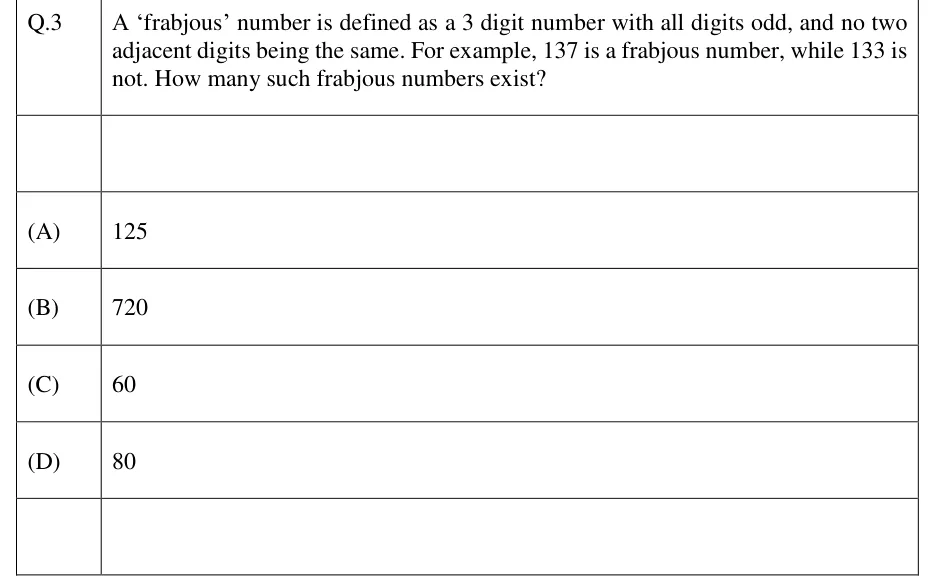
A ‘frabjous’ number is defined as a 3 digit number with all digits odd, and no two adjacent digits being the same. For example, 137 is a frabjous number, while 133 is not. How many such frabjous numbers exist?
- (A)
125
- (B)
720
- (C)
60
- (D)
80

A ‘frabjous’ number is defined as a 3 digit number with all digits odd, and no two adjacent digits being the same. For example, 137 is a frabjous number, while 133 is not. How many such frabjous numbers exist?
125
720
60
80
ANSWER
There are frabjous numbers, so the answer is (D) 80.
Official answer: DSource: Official answer key, GATE 2023 IN (IIT Kanpur)
The odd digits are , so each position can take one of digits. Zero is even and can never appear, so there is no leading-zero case to exclude.
Hundreds digit: any odd digit, so choices.
Tens digit: odd and different from the hundreds digit (the two are adjacent), so choices.
Units digit: odd and different from the tens digit only. It is not adjacent to the hundreds digit, so it may repeat that digit ( is allowed). That gives choices.
The choices are made one after another and each count does not depend on which digit was picked earlier, so by the multiplication principle: .
Check with the complement. All-odd 3-digit numbers: . Let = first two digits equal ( numbers) and = last two digits equal ( numbers). = all three digits equal ( numbers). By inclusion-exclusion, numbers with at least one equal adjacent pair . So frabjous numbers .
The answer is , which is option (D).
KEY IDEA
Count position by position. The first digit has 5 odd choices. Each later digit must differ only from the digit right before it, so it has 4 choices. The multiplication principle then gives .
WATCH OUT FOR
Reading "no two adjacent digits the same" as "all three digits different" gives , option (C). That wrongly rules out numbers like , where only the non-adjacent first and last digits match. Ignoring the adjacency rule altogether gives , option (A).
From the GATE 2023 IN paper. Every question of this paper · Download the full paper · All 58 Numerical questions, with notes