IAE Academy

GATE 2018 IN GA Q.8: solution and answer

GATE 2018 · INGA Q.8 · 2 marks · MCQ

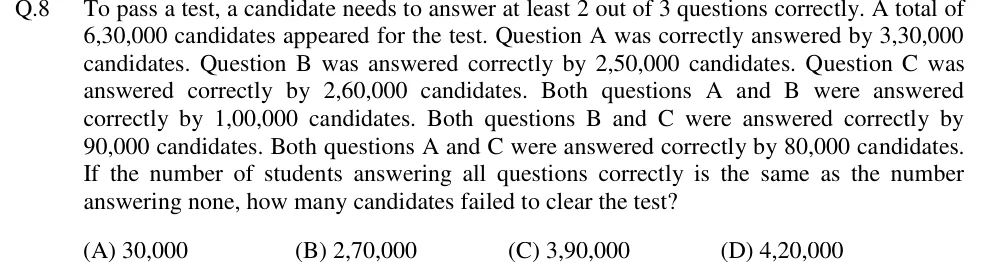
To pass a test, a candidate needs to answer at least 2 out of 3 questions correctly. A total of 6,30,000 candidates appeared for the test. Question A was correctly answered by 3,30,000 candidates. Question B was answered correctly by 2,50,000 candidates. Question C was answered correctly by 2,60,000 candidates. Both questions A and B were answered correctly by 1,00,000 candidates. Both questions B and C were answered correctly by 90,000 candidates. Both questions A and C were answered correctly by 80,000 candidates. If the number of students answering all questions correctly is the same as the number answering none, how many candidates failed to clear the test?

  1. (A)

    30,000

  2. (B)

    2,70,000

  3. (C)

    3,90,000

  4. (D)

    4,20,000

See the question in the paper

Answer and solution

ANSWER

4,20,000 candidates failed to clear the test (option D).

Official answer: DSource: Official answer key, GATE 2018 IN (IIT Guwahati)

  1. Let be the number of candidates who answered all three questions correctly. By the given condition, candidates also answered none correctly. Total .

  2. Candidates with at least one correct answer: .

  3. Inclusion-exclusion for three sets: , so

  4. Equate the two expressions: .

  5. Each pairwise count includes the all-three group, so the number with exactly two correct is .

  6. Passed (at least 2 correct) = exactly two + all three .

  7. Failed , which is option (D).

  8. Check: exactly one correct . Then , so every candidate is counted. The failures are the exactly-one group plus the none group: , which agrees.

KEY IDEA

Three-set inclusion-exclusion with one unknown. Call the all-three count ; it is also the none count. Writing the union two ways, as and as singles minus pairs plus , fixes . Passing means exactly two correct plus all three correct, and exactly two correct is the sum of the pairwise counts minus .

WATCH OUT FOR

There are three common traps. (1) Taking the passers to be the sum of the pairwise counts (2,70,000, option B). That counts the all-three group three times. (2) Counting only the exactly-one group as failures (3,90,000, option C) and forgetting the 30,000 who got none right. (3) Reporting (option A), which is the all-three count and not the number who failed.

From the GATE 2018 IN paper. Every question of this paper · Download the full paper · All 58 Numerical questions, with notes

More Numerical questions