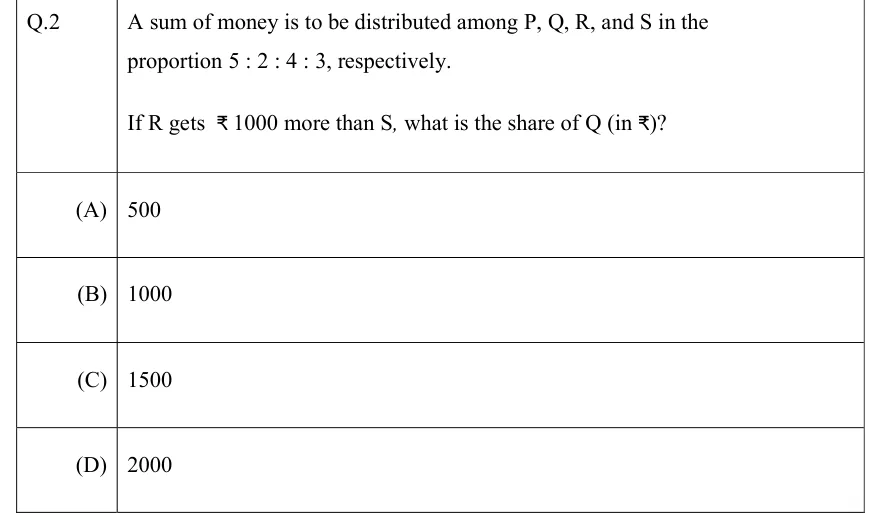
A sum of money is to be distributed among P, Q, R, and S in the proportion 5 : 2 : 4 : 3, respectively.
If R gets Rs. 1000 more than S, what is the share of Q (in Rs.)?
- (A)
500
- (B)
1000
- (C)
1500
- (D)
2000

A sum of money is to be distributed among P, Q, R, and S in the proportion 5 : 2 : 4 : 3, respectively.
If R gets Rs. 1000 more than S, what is the share of Q (in Rs.)?
500
1000
1500
2000
ANSWER
Q's share is Rs. 2000, which is option (D).
Official answer: DSource: Official answer key, GATE 2022 EC (IIT Kharagpur)
Shares in a given ratio are all multiples of one common unit. Let P, Q, R and S get , , and rupees, for some .
The difference between two shares is the difference of their ratio terms times : .
We are told R gets Rs. 1000 more than S, so , which gives .
Q's share is , so Q gets Rs. 2000. That is option (D).
Check: the shares are Rs. 5000, 2000, 4000 and 3000 (ratio ), and R gets rupees more than S, as the question requires.
KEY IDEA
In a ratio split, every share is (its ratio term) × (one common unit ). A given difference between two shares fixes straight away: . You do not need the total sum at all.
WATCH OUT FOR
Treating the Rs. 1000 difference as if it were the whole sum and dividing it in the ratio (which gives , not an option). Another slip is to stop at and pick option (B), forgetting that Q's share is , not .
From the GATE 2022 EC paper. Every question of this paper · Download the full paper · All 58 Numerical questions, with notes