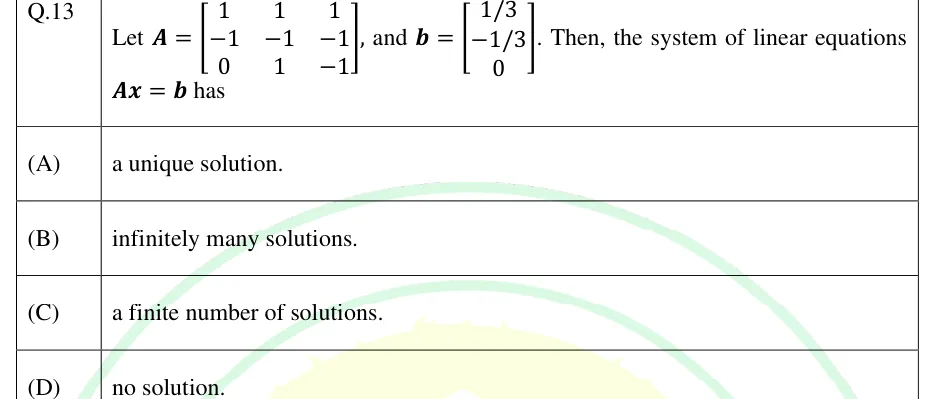
Let , and . Then, the system of linear equations has
- (A)
a unique solution.
- (B)
infinitely many solutions.
- (C)
a finite number of solutions.
- (D)
no solution.

Let , and . Then, the system of linear equations has
a unique solution.
infinitely many solutions.
a finite number of solutions.
no solution.
ANSWER
(B) infinitely many solutions. Here , which leaves a one-parameter family of solutions .
Official answer: BSource: Official answer key, GATE 2025 EE (IIT Roorkee)
Write the augmented matrix:
Apply . Row 2 of the augmented matrix is exactly times row 1, right-hand side included, so it becomes :
The two remaining coefficient rows and are not multiples of each other, so . (Check: because rows 1 and 2 are proportional, so the rank must be less than 3.)
The zero row has a zero right-hand side, so no row reads . Hence as well.
Rank test (Rouché–Capelli): . The system is consistent and has free variable, so it has infinitely many solutions.
Explicitly, with : the third row gives , so . The first row gives , so . Every real gives a solution; for example gives . Check: , , . The answer is (B).
KEY IDEA
Compare with . If they differ, there is no solution. If they are equal to , the solution is unique. If they are equal but less than , there are infinitely many solutions. In this question row 2 is times row 1 and follows the same relation (), so the dependent equation adds no new information and no contradiction.
WATCH OUT FOR
Seeing and choosing 'no solution' (D) straight away. A singular matrix only rules out a unique solution. You still have to compare the rank of with the rank of the augmented matrix. Option (C) is a trap: a linear system has exactly zero, one or infinitely many solutions, never a finite number greater than one.
From the GATE 2025 EE paper. Every question of this paper · Download the full paper · All 46 Linear algebra questions, with notes