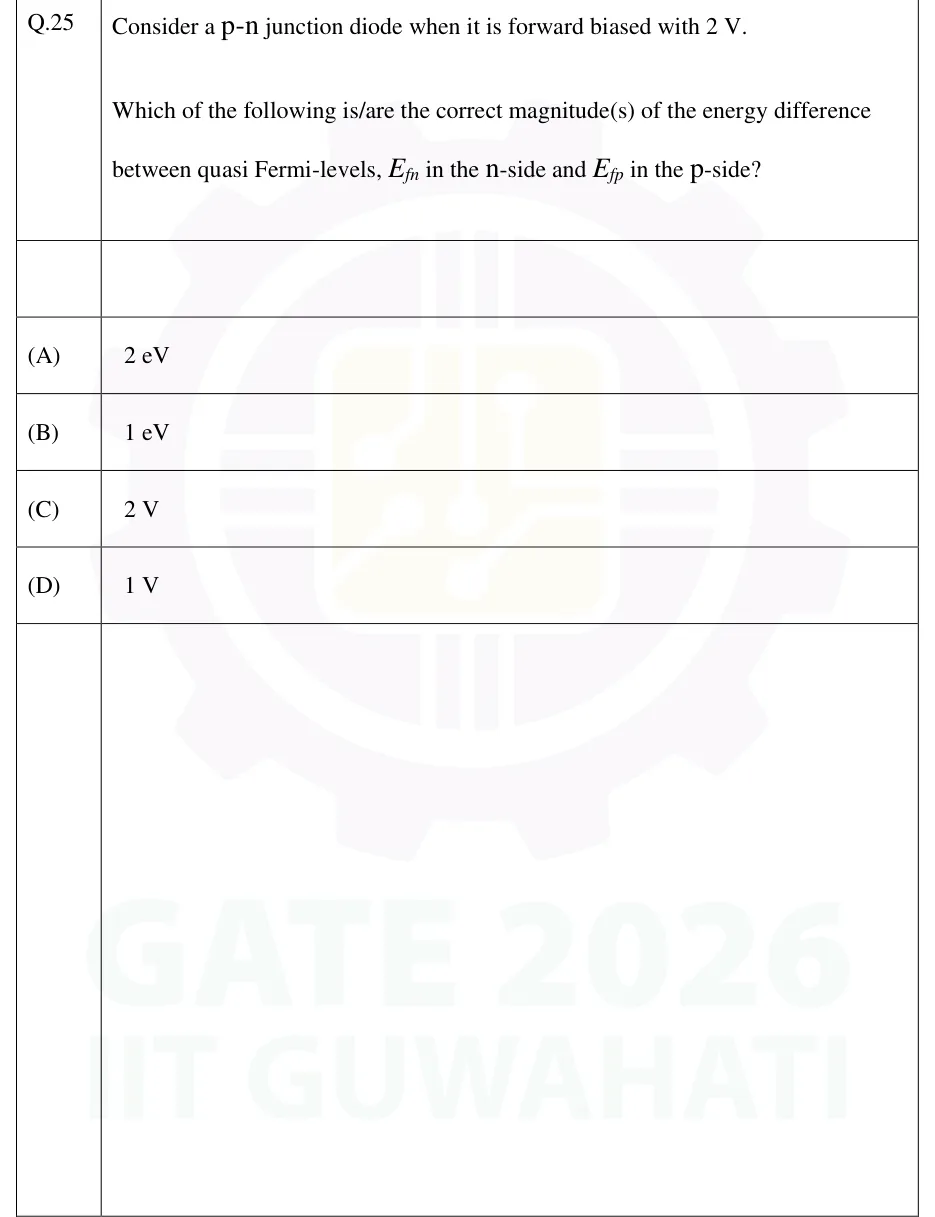
Consider a p-n junction diode when it is forward biased with 2 V. Which of the following is/are the correct magnitude(s) of the energy difference between quasi Fermi-levels, in the n-side and in the p-side?
- (A)
2 eV
- (B)
1 eV
- (C)
2 V
- (D)
1 V

Consider a p-n junction diode when it is forward biased with 2 V. Which of the following is/are the correct magnitude(s) of the energy difference between quasi Fermi-levels, in the n-side and in the p-side?
2 eV
1 eV
2 V
1 V
ANSWER
The magnitude of the quasi-Fermi level splitting equals , so only option (A) is correct.
Official answer: ASource: Official answer key, GATE 2026 EC (IIT Guwahati)
Under thermal equilibrium (V = 0), electron and hole populations across the p-n junction are both described by a single, common Fermi level : .
Under forward bias, minority-carrier injection at the junction pushes both carrier populations far from their equilibrium values, so a single Fermi level can no longer describe both. Two separate quasi-Fermi levels are introduced: for electrons and for holes.
Deep in the quasi-neutral bulk regions on each side (away from the depletion region), majority carriers remain close to local equilibrium, so and are each essentially flat (constant with position) through most of each neutral region.
The applied forward bias does work per carrier as it is transported across the junction; this work manifests exactly as the separation between the two flat quasi-Fermi levels in the neutral regions: .
Substituting the given bias : .
Since the question asks for an ENERGY difference, the answer must be expressed in eV, not V — this immediately rules out (C) 2 V and (D) 1 V on dimensional grounds, independent of their numeric value.
Therefore the magnitude of the quasi-Fermi level splitting is exactly , matching option (A); option (B) 1 eV would require an applied bias of 1 V, which is not the value given in the problem.
KEY IDEA
Under forward bias , the depletion region is no longer in equilibrium, so a single Fermi level no longer describes it; separate quasi-Fermi levels (electrons) and (holes) are needed. In the quasi-neutral bulk on each side, each carrier type stays close to local equilibrium, so and are each nearly flat there. The applied bias does work on carriers crossing the junction, and this work appears entirely as the split between the two (flat, bulk-side) quasi-Fermi levels: . With , the magnitude is .
WATCH OUT FOR
Reporting the answer as "2 V" (option C) or "1 V" (option D) by treating the quasi-Fermi level separation as a voltage rather than an energy — a dimensional slip, since is an energy and must be quoted in eV (numerically equal to the bias in volts only because of the eV/V unit correspondence, ). A second common mistake is halving the bias (giving 1 eV, option B) by mistakenly splitting the applied voltage symmetrically between the two quasi-Fermi levels relative to the equilibrium Fermi level, instead of recognizing that the full appears as their mutual separation.
From the GATE 2026 EC paper. Every question of this paper · Download the full paper · All 6 P-N junction questions, with notes