
IAE Academy

GATE 2018 EC Q.7: solution and answer

GATE 2018 · ECQ.7 · 1 mark · MCQ

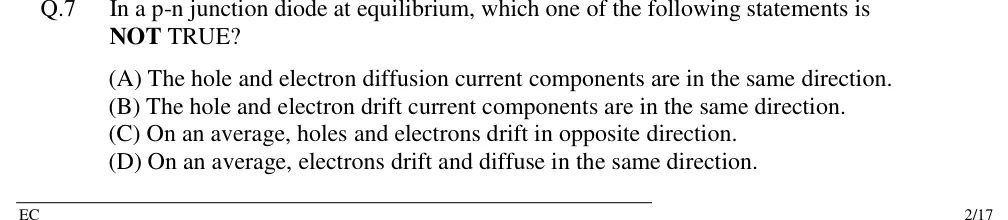
In a p-n junction diode at equilibrium, which one of the following statements is NOT TRUE?

  1. (A)

    The hole and electron diffusion current components are in the same direction.

  2. (B)

    The hole and electron drift current components are in the same direction.

  3. (C)

    On an average, holes and electrons drift in opposite direction.

  4. (D)

    On an average, electrons drift and diffuse in the same direction.
See the question in the paper

Answer and solution

ANSWER

The correct answer is (D): "On an average, electrons drift and diffuse in the same direction" is the false (NOT TRUE) statement.

Official answer: DSource: Official answer key, GATE 2018 EC (IIT Guwahati)

  1. At equilibrium the net current is zero for each carrier type separately: (hole diffusion current) (hole drift current), and (electron diffusion current) (electron drift current).

  2. The built-in field inside the depletion region points from the n-side to the p-side (n-side carries net positive space charge from ionised donors, p-side net negative space charge from ionised acceptors).

  3. Holes (positive charge) are pushed along : hole drift motion — and hence hole drift current, since current direction matches the motion direction for a positive carrier — flows from the n-side to the p-side.

  4. Holes diffuse from where their concentration is high (p-side, majority carriers) to where it is low (n-side): hole diffusion current flows from the p-side to the n-side — opposite to the hole drift current, consistent with zero net hole current.

  5. Electrons (negative charge) are pushed opposite to : electron drift motion is from the p-side to the n-side. Since conventional current is opposite to electron motion, the electron drift current flows from the n-side to the p-side.

  6. Electrons diffuse from where their concentration is high (n-side, majority carriers) to where it is low (p-side): electron diffusion motion is from the n-side to the p-side. The corresponding electron diffusion current (opposite to motion) flows from the p-side to the n-side.

  7. Check (A): hole diffusion current (p-side n-side) and electron diffusion current (p-side n-side) — same direction, so (A) is TRUE.

  8. Check (B): hole drift current (n-side p-side) and electron drift current (n-side p-side) — same direction, so (B) is TRUE.

  9. Check (C): hole drift motion (n-side p-side) and electron drift motion (p-side n-side) are opposite, so the statement 'holes and electrons drift in opposite direction' is TRUE.

  10. Check (D): electron drift motion (p-side n-side) and electron diffusion motion (n-side p-side) are OPPOSITE to each other, so the claim in (D), that electrons drift and diffuse in the same direction, is FALSE. This makes (D) the statement that is NOT TRUE.

KEY IDEA

At thermal equilibrium in a p-n junction, drift and diffusion currents cancel separately for holes and for electrons. For each carrier, the drift direction (driven by the built-in field) and the diffusion direction (driven by its own concentration gradient) are opposite to each other — this is exactly what makes the net current zero, and it is the physics tested by option (D).

WATCH OUT FOR

Conflating "current direction" with "physical motion direction" for electrons. Because electrons carry negative charge, their conventional current flows opposite to their physical motion, so a careless solver equates "electron drift and diffusion currents are in the same direction" with "electron drift and diffusion motions are in the same direction" — these are two different (and here, oppositely-signed) comparisons, and mixing them up can flip the answer between (B) and (D).

From the GATE 2018 EC paper. Every question of this paper · Download the full paper · All 6 P-N junction questions, with notes

More P-N junction questions