IAE Academy

GATE 2026 EC Q.21: solution and answer

GATE 2026 · ECQ.21 · 1 mark · MCQ

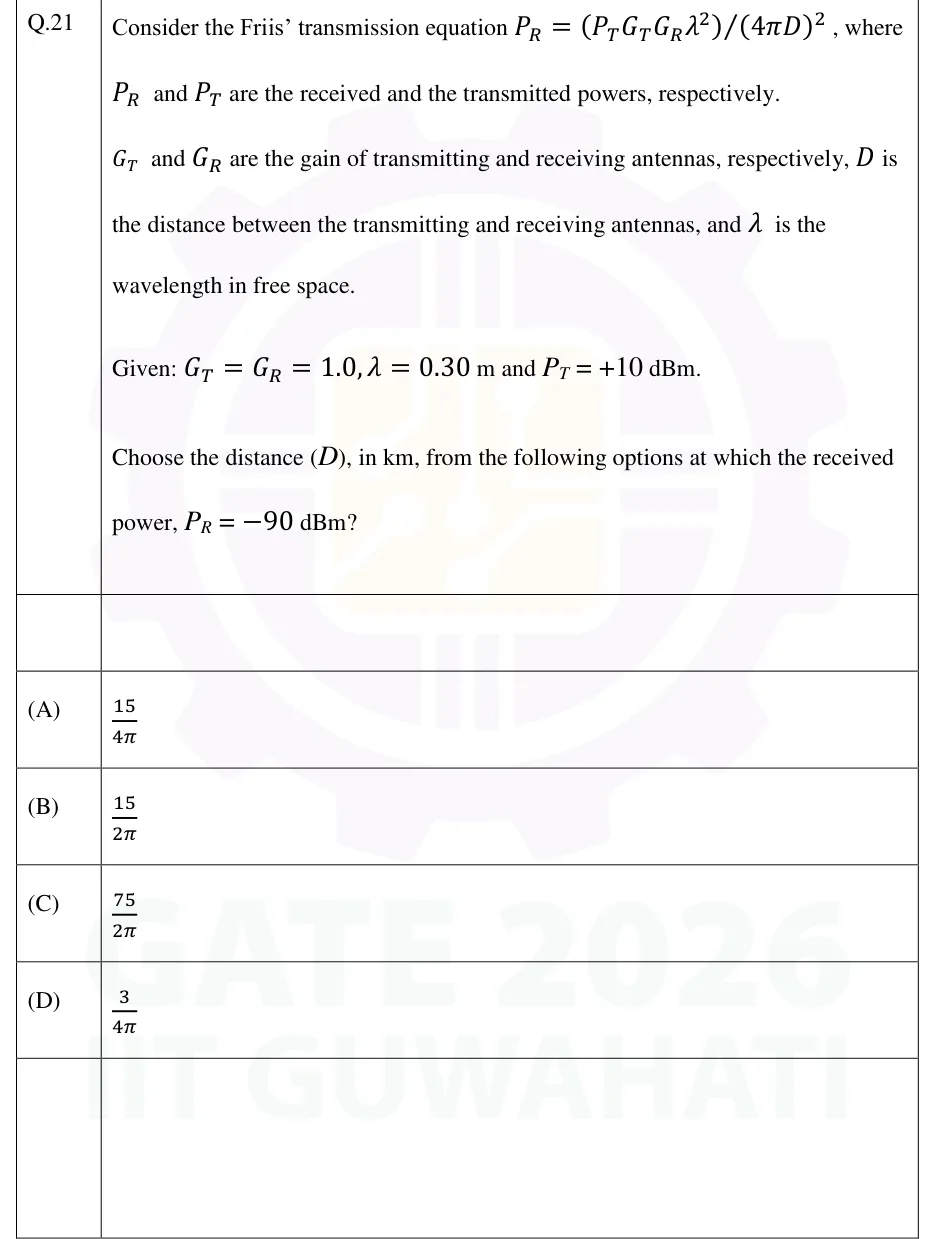
Consider the Friis' transmission equation , where and are the received and the transmitted powers, respectively. and are the gain of transmitting and receiving antennas, respectively, is the distance between the transmitting and receiving antennas, and is the wavelength in free space.

Given: , and .

Choose the distance (), in km, from the following options at which the received power, ?

  1. (A)

  2. (B)

  3. (C)

  4. (D)

See the question in the paper

Answer and solution

ANSWER

(B) km, about 2.39 km

Official answer: BSource: Official answer key, GATE 2026 EC (IIT Guwahati)

  1. With , the Friis equation becomes

  2. Both powers are given in dBm, so their difference is the power ratio in dB: . That gives . (Check: and , and their ratio is .)

  3. Take the square root: . In dB terms, the free-space path loss is , so .

  4. Solve for the distance:

  5. Convert to km: . This is option (B).

KEY IDEA

Subtracting one dBm value from another gives a dB ratio. Here is the free-space path loss with unity-gain antennas, and . Because Friis loss depends on the square of distance, 100 dB of power loss means , not .

WATCH OUT FOR

The usual mistakes are about the square. One is forgetting the square root, which leaves and a distance far larger than any option. Another is converting the 100 dB power ratio with and then taking a square root as well, which applies the halving twice. A third is leaving in metres ( m) and not turning it into km before comparing with the options. It also helps to remember that dBm minus dBm is a plain dB ratio, so there is no need to convert to watts.

From the GATE 2026 EC paper. Every question of this paper · Download the full paper · All 2 Antennas questions, with notes