IAE Academy

GATE 2025 EE Q.44: solution and answer

GATE 2025 · EEQ.44 · 2 marks · MCQ

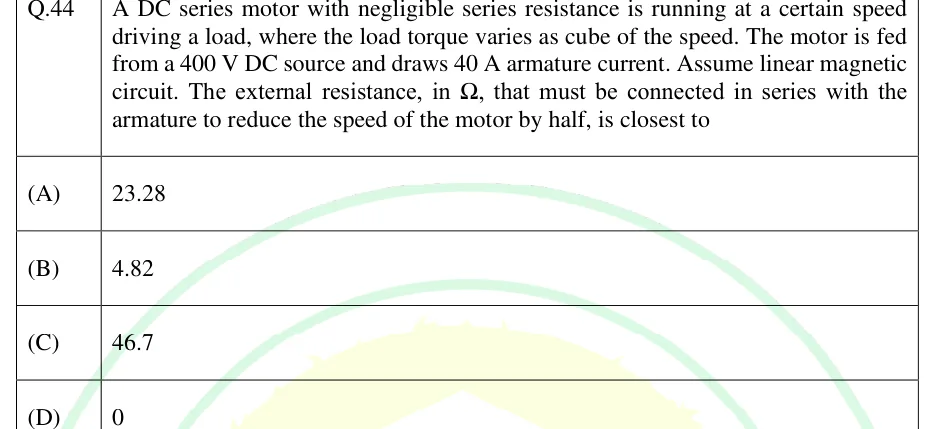
A DC series motor with negligible series resistance is running at a certain speed driving a load, where the load torque varies as cube of the speed. The motor is fed from a 400 V DC source and draws 40 A armature current. Assume linear magnetic circuit. The external resistance, in Ω, that must be connected in series with the armature to reduce the speed of the motor by half, is closest to

  1. (A)

    23.28

  2. (B)

    4.82

  3. (C)

    46.7

  4. (D)

    0

See the question in the paper

Answer and solution

ANSWER

The external resistance required is R ≈ 23.28 Ω, so option A is correct.

Official answer: ASource: Official answer key, GATE 2025 EE (IIT Roorkee)

  1. Since the magnetic circuit is linear and this is a series motor, flux is proportional to armature current: φ ∝ Ia. Hence electromagnetic torque, .

  2. Initial condition (no external resistance, negligible series resistance): armature current , terminal voltage , so back-EMF , at speed .

  3. The load torque varies as the cube of speed, . At steady state the motor's electromagnetic torque equals the load torque at every operating speed. When the speed is halved, , so

  4. Since :

  5. Back-EMF depends on both flux and speed, and here , so :

  6. So

  7. With the external resistance now inserted in the armature circuit (series/armature resistance itself still negligible):

  8. Solving: This matches option (A).

KEY IDEA

In a DC series motor with a linear magnetic circuit, flux is proportional to armature current (φ ∝ Ia), so electromagnetic torque T ∝ Ia², and back-EMF E ∝ φN ∝ Ia·N. Combining the load's T ∝ N³ law with the motor's T ∝ Ia² law, and then using the circuit equation V = E + Ia·R, pins down the external resistance needed for a given speed change.

WATCH OUT FOR

Assuming back-EMF stays proportional to speed alone (E ∝ N) as in a shunt/separately excited motor, forgetting that in a series motor with linear magnetic circuit, flux itself changes with armature current, so E ∝ φN ∝ Ia·N — missing this collapses the whole ratio calculation.

From the GATE 2025 EE paper. Every question of this paper · Download the full paper · All 8 DC machines questions, with notes

More DC machines questions