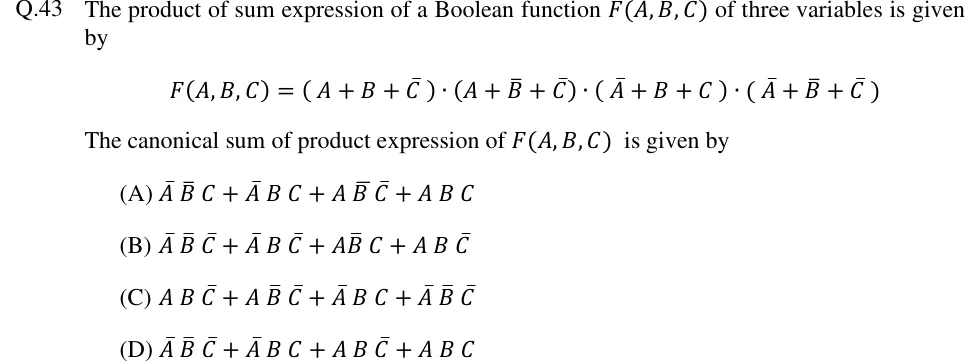
The product of sum expression of a Boolean function of three variables is given by
The canonical sum of product expression of is given by
- (A)
- (B)
- (C)
- (D)

The product of sum expression of a Boolean function of three variables is given by
The canonical sum of product expression of is given by
ANSWER
, which is option (B).
Official answer: BSource: Official answer key, GATE 2018 IN (IIT Guwahati)
Complement is written with an overline, . Each sum term contains all three variables, so it is a maxterm. A maxterm is 0 for exactly one input: the one that makes every literal 0. An uncomplemented variable must be 0 and a complemented variable () must be 1.
only at , so it is . only at , so it is .
only at , so it is . only at , so it is .
So : is 0 at inputs 1, 3, 4 and 7 and 1 at every other input. The canonical SOP therefore uses the complementary minterm set: .
Write out each minterm. A 0 bit gives the complemented literal and a 1 bit gives the plain literal: (000), (010), (101), (110).
This is option (B). Check: at the product is , which agrees with being present. The distractors: (A) is , the maxterm indices wrongly used as minterms. (C) is and (D) is . Both include inputs where .
KEY IDEA
In a canonical POS, each sum term is a maxterm and marks one input where . Read off its index by setting plain variables to 0 and complemented ones to 1. The canonical SOP is the sum of the minterms with every other index: .
WATCH OUT FOR
Using the maxterm indices directly as minterms, which gives = option (A). A second mistake is reading a maxterm's index the minterm way (). That turns into index 6 instead of 1, and the whole set comes out wrong.
From the GATE 2018 IN paper. Every question of this paper · Download the full paper · All 22 Boolean logic questions, with notes