
IAE Academy

GATE 2025 DA Q.57: solution and answer

GATE 2025 · DAQ.57 · 2 marks · MSQ

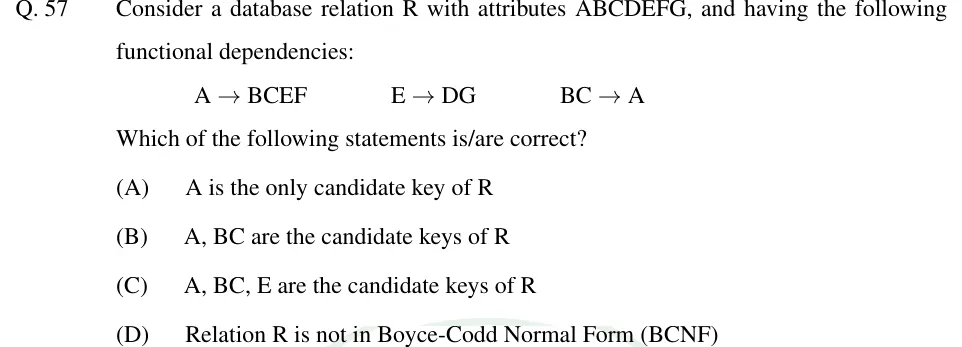
Consider a database relation R with attributes ABCDEFG, and having the following functional dependencies:

A → BCEF E → DG BC → A

Which of the following statements is/are correct?

  1. (A)

    A is the only candidate key of R

  2. (B)

    A, BC are the candidate keys of R

  3. (C)

    A, BC, E are the candidate keys of R

  4. (D)

    Relation R is not in Boyce-Codd Normal Form (BCNF)
See the question in the paper

Answer and solution

ANSWER

The correct options are (B) and (D): the candidate keys are exactly A and BC, and R is not in BCNF because of E → DG.

Official answer: B, DSource: Official answer key, GATE 2025 DA (IIT Roorkee)

  1. Closure of : gives , then adds . So , which is all of R. is a superkey, and being a single attribute it is a candidate key.

  2. Closure of : gives , and is all of R, so . Also and since no FD has or alone on its left side. So is a minimal superkey, hence a candidate key. Therefore is also a candidate key, and (A) is false.

  3. Closure of : gives , which is not all of R. So is not a key, and (C) is false.

  4. Are there any other candidate keys? The only FDs that put on the right side are . So a set that does not contain can reach only if it contains both and . Such a set contains and is not minimal. Hence the candidate keys are exactly and , and (B) is true.

  5. BCNF needs the left side of every non-trivial FD to be a superkey. and satisfy this. is non-trivial and is not a superkey (step 3), so it violates BCNF.

  6. So R is not in BCNF, and (D) is true. The correct options are (B) and (D).

KEY IDEA

Find candidate keys by computing attribute closures. Then check every non-trivial FD for a superkey on its left side to test BCNF. Any key not containing A must contain BC, since BC → A is the only way to derive A.

WATCH OUT FOR

Stopping at the key A and calling it the only candidate key, which misses that BC → A makes BC a key too. Another slip is treating E as a key because it determines D and G, when E+ = {E, D, G} does not include A, B, C or F.

From the GATE 2025 DA paper. Every question of this paper · Download the full paper · All 6 Normal forms questions, with notes

More Normal forms questions