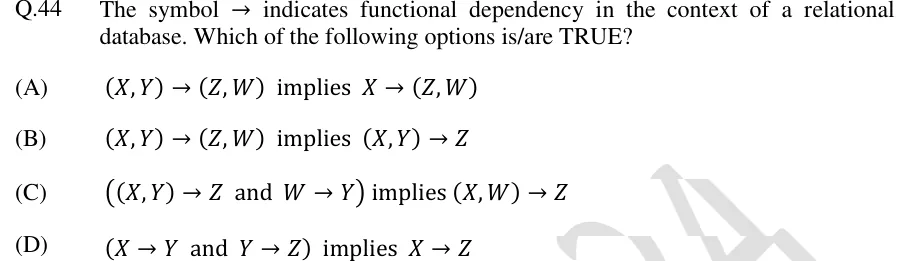
The symbol indicates functional dependency in the context of a relational database. Which of the following options is/are TRUE?
- (A)
implies
- (B)
implies
- (C)
and implies
- (D)
and implies

The symbol indicates functional dependency in the context of a relational database. Which of the following options is/are TRUE?
implies
implies
and implies
and implies
ANSWER
B, C and D are true; A is false.
Official answer: B, C, DSource: Official answer key, GATE 2024 CS1 (IISc Bengaluru)
Check each option with Armstrong's axioms (reflexivity, augmentation, transitivity) and the rules derived from them (decomposition, union).
(A) says that and together fix and . It does not say that alone does. Counterexample: take a relation with the rows and . The two rows differ on , so holds. The two rows agree on but differ on , so fails. A is false.
(B) Decomposition: from we get and . B is true.
(C) Given , augment with to get . Given , transitivity gives . C is true.
(D) Transitivity: and give . D is true.
Options B, C and D are true. Option A is false.
KEY IDEA
A functional dependency can be weakened on the right side (decomposition) and chained (transitivity, with augmentation), but it cannot be weakened on the left side: dropping an attribute from the determinant is not allowed.
WATCH OUT FOR
Treating as implying , that is, dropping an attribute from the left side. This is not an Armstrong rule. Only the right side can be split.
From the GATE 2024 CS1 paper. Every question of this paper · Download the full paper · All 19 Normal forms questions, with notes