IAE Academy

GATE 2026 CS1 Q.30: solution and answer

GATE 2026 · CS1Q.30 · 1 mark · MSQ

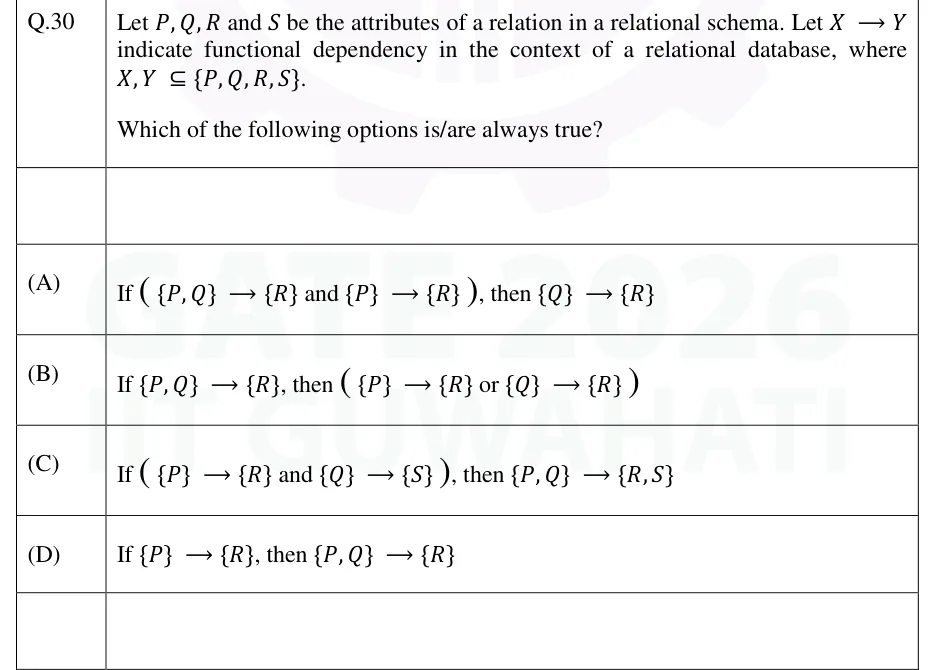
Let and be the attributes of a relation in a relational schema. Let indicate functional dependency in the context of a relational database, where .

Which of the following options is/are always true?

  1. (A)

    If ( and ), then

  2. (B)

    If , then ( or )

  3. (C)

    If ( and ), then

  4. (D)

    If , then

See the question in the paper

Answer and solution

ANSWER

The always-true implications are (C) and (D).

Official answer: C, DSource: Official answer key, GATE 2026 CS1 (IIT Guwahati)

  1. Test each implication with Armstrong's axioms, or with a small counterexample relation. In a counterexample, the attribute can be given the same value in every tuple, so it plays no part.

  2. (A) already implies , so the premise tells us nothing about alone. Take the tuples . Then holds, because gives only and the other values are distinct. So holds too. But gives both and , so fails. (A) is not always true.

  3. (B) Take . All pairs are distinct, so holds. But gives and , so fails. Also gives and , so fails. Neither disjunct holds, so (B) is not always true.

  4. (C) Augment with to get . Augment with to get . By transitivity, and give . (C) is always true. This is the union rule applied to the augmented dependencies.

  5. (D) Augment with to get . Since , decomposition gives . (D) is always true.

  6. Hence the options that are always true are (C) and (D).

KEY IDEA

Check each implication with Armstrong's axioms (augmentation, transitivity, decomposition, union). If an implication cannot be derived, build a small relation that satisfies the premise and violates the conclusion.

WATCH OUT FOR

Thinking that a determinant made of two attributes can be split, so that would imply or (option B). Another slip is reading together with as saying something about alone (option A). Adding attributes to the left side of a dependency is always safe, but removing them is not.

From the GATE 2026 CS1 paper. Every question of this paper · Download the full paper · All 19 Normal forms questions, with notes

More Normal forms questions