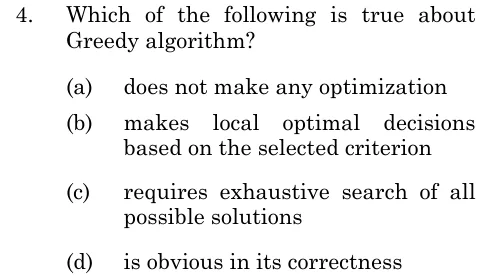
Which of the following is true about Greedy algorithm?
- (A)
does not make any optimization
- (B)
makes local optimal decisions based on the selected criterion
- (C)
requires exhaustive search of all possible solutions
- (D)
is obvious in its correctness

Which of the following is true about Greedy algorithm?
does not make any optimization
makes local optimal decisions based on the selected criterion
requires exhaustive search of all possible solutions
is obvious in its correctness
ANSWER
The correct option is (b): a greedy algorithm makes locally optimal decisions based on the selected criterion.
Official answer: BSource: ISRO's final answer key of 15 May 2026
A greedy algorithm builds a solution step by step. At each step it picks the choice that looks best under a fixed selection criterion, and it never reconsiders that choice.
Option (a) is false: greedy methods are used for optimization problems. Examples are Huffman coding, Kruskal's and Prim's algorithms, and activity selection.
Option (b) matches the definition: each decision is locally optimal under the chosen criterion, such as the smallest edge weight or the earliest finish time.
Option (c) is false: exhaustive search of all possible solutions is brute force or backtracking, not greedy.
Option (d) is false: a greedy choice is not obviously correct. Correctness needs a proof, using the greedy-choice property and optimal substructure, and for some problems (such as 0/1 knapsack) a greedy strategy gives wrong answers.
So the only true statement is (b).
KEY IDEA
A greedy algorithm commits at every step to the locally best choice under a fixed criterion and never revisits it. It is an optimization technique, but its correctness must be proved for each problem.
WATCH OUT FOR
Assuming a greedy algorithm always gives the optimal answer (option d), or confusing it with exhaustive search or backtracking (option c). Greedy fails on problems such as 0/1 knapsack.
From the ISRO CS 2025 paper. Every question of this paper · The full paper (PDF, ISRO) · All 2 ISRO Design techniques questions, with notes