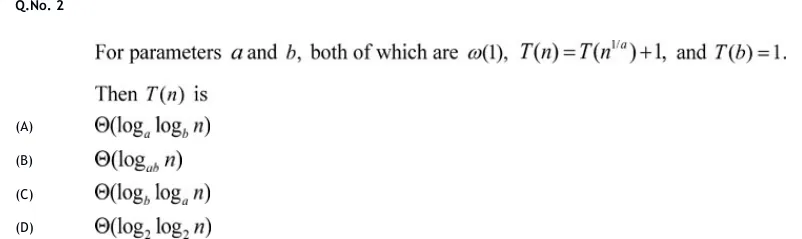
For parameters and , both of which are , , and .
Then is
- (A)
- (B)
- (C)
- (D)

For parameters and , both of which are , , and .
Then is
ANSWER
, so the correct option is (A).
Official answer: ASource: Official answer key, GATE 2020 CS (IIT Delhi)
Let , so . We track .
Compute the effect of the recurrence's argument under this substitution: , so . Thus becomes .
The base case corresponds to , i.e. .
Unroll directly: . This reaches the base case when , i.e. . Hence (no need to invoke the Master theorem, which applies to divide-and-conquer recurrences of the form and is not the right tool here; direct unrolling suffices).
Substitute back : , which is option (A).
KEY IDEA
Substituting turns the "take a-th root of the argument" recurrence into the familiar "divide the exponent by " recurrence , whose solution is ; undoing the substitution gives the nested double logarithm .
WATCH OUT FOR
Treating the two parameters and as combinable into a single log base (picking option (B), ) instead of recognizing that controls how many times you must take roots (an outer log) while sets the base at which the argument bottoms out (an inner log) — the two play structurally different roles and cannot be merged into one log base.
From the GATE 2020 CS paper. Every question of this paper · Download the full paper · All 14 Complexity questions, with notes