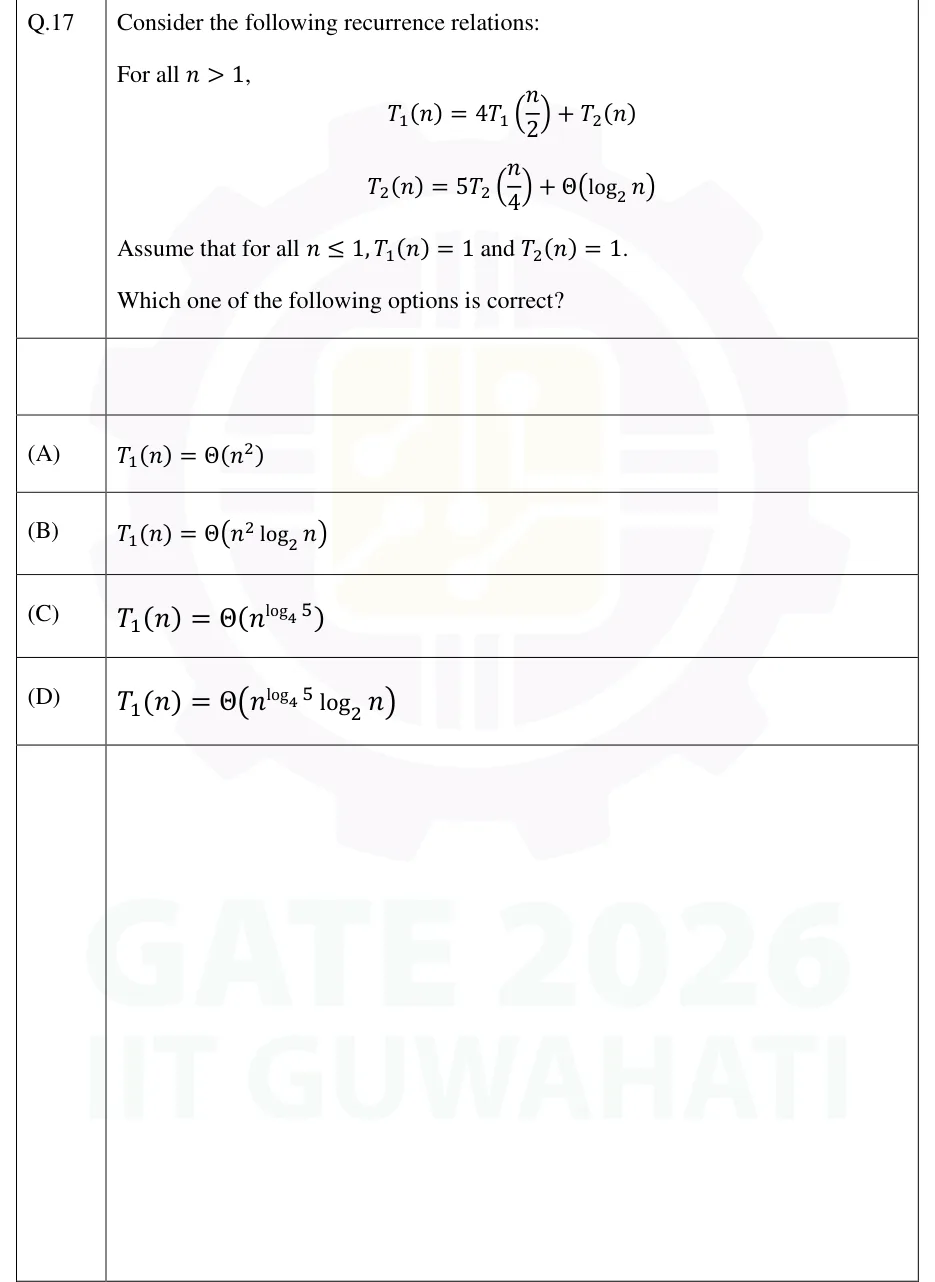
Consider the following recurrence relations:
For all ,
Assume that for all , and .
Which one of the following options is correct?
- (A)
- (B)
- (C)
- (D)

Consider the following recurrence relations:
For all ,
Assume that for all , and .
Which one of the following options is correct?
ANSWER
T1(n) = Θ(n²), matching option (A)
Official answer: ASource: Official answer key, GATE 2026 CS1 (IIT Guwahati)
Solve the inner recurrence T2(n) = 5T2(n/4) + Θ(log₂n) via the Master theorem: a=5, b=4, so the watershed function is n^{log_4 5} ≈ n^{1.161}.
Since f(n) = Θ(log₂n) = O(n^{log_4 5 - ε}) for ε = 1 > 0, Master theorem Case 1 applies, giving T2(n) = Θ(n^{log_4 5}).
Substitute this closed form into the outer recurrence: T1(n) = 4T1(n/2) + Θ(n^{log_4 5}).
Apply the Master theorem to T1: a=4, b=2, so the watershed function is n^{log_2 4} = n².
Compare f(n) = Θ(n^{log_4 5}) ≈ Θ(n^{1.161}) with n²: since log_4 5 < 2, f(n) = O(n^{2-ε}) for ε = 2 - log_4 5 > 0, so Master theorem Case 1 applies again.
Therefore T1(n) = Θ(n²), which is option (A).
KEY IDEA
Solve the inner recurrence T2 first with the Master theorem, then substitute the resulting Θ-bound into the outer recurrence T1 and apply the Master theorem a second time.
WATCH OUT FOR
Applying the Master theorem to T1 using the printed f(n) = T2(n) symbolically (or assuming T2(n) = Θ(n) / Θ(log n) without first solving it), instead of substituting the actual closed form Θ(n^{log_4 5}) for T2(n) before comparing against n^{log_2 4} = n².
From the GATE 2026 CS1 paper. Every question of this paper · Download the full paper · All 14 Complexity questions, with notes