IAE Academy

GATE 2025 EC Q.37: solution and answer

GATE 2025 · ECQ.37 · 2 marks · MCQ

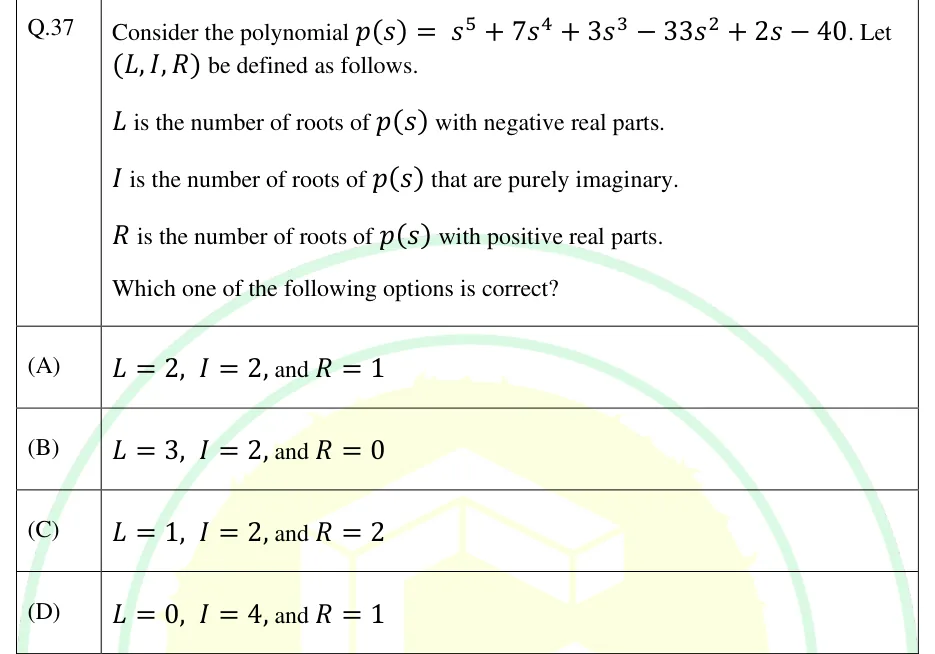
Consider the polynomial . Let be defined as follows.

is the number of roots of with negative real parts.

is the number of roots of that are purely imaginary.

is the number of roots of with positive real parts.

Which one of the following options is correct?

  1. (A)

    , and

  2. (B)

    , and

  3. (C)

    , and

  4. (D)

    , and

See the question in the paper

Answer and solution

ANSWER

(A) , and . The roots of are .

Official answer: ASource: Official answer key, GATE 2025 EC (IIT Roorkee)

  1. Routh array, first two rows (coefficients taken alternately): and .

  2. Row : and . Dividing a row by a positive number does not change any sign, so divide by to get .

  3. Row (using the scaled row): and , so the row is .

  4. Row : . The whole row is zero. This is the special case where has roots placed symmetrically about the origin.

  5. Auxiliary polynomial from the row: . Its roots are , and they are also roots of . Replace the zero row with the coefficients of , so the row is . The row is then .

  6. First column: . There is exactly one sign change, between the and entries, so has one root with positive real part: .

  7. From the auxiliary row down (the entries ) there is no sign change, so has no root in the right half-plane. Its roots are symmetric about the origin, so it has none in the left half-plane either, and both lie on the axis: . The remaining roots have negative real parts: .

  8. Check by factoring: . The roots are , which gives . This is option (A).

KEY IDEA

A whole row of zeros in the Routh array means has roots placed symmetrically about the origin, and those roots are the roots of the auxiliary polynomial built from the row above. After replacing the zero row with , the total number of sign changes in the first column counts all right-half-plane roots. The sign changes from the auxiliary row downwards count only the auxiliary polynomial's right-half-plane roots. Here that count is zero, so both roots of lie on the axis.

WATCH OUT FOR

Stopping at the zero row, or putting a small in place of the whole zero row (the method is only for a single zero in the first column). That hides the pair and leads to option (B) or (C). A second trap is reading the one sign change as the only non-left-half-plane root and forgetting to count the imaginary pair: that gives , which matches no option.

From the GATE 2025 EC paper. Every question of this paper · Download the full paper · All 15 Routh–Hurwitz questions, with notes

More Routh–Hurwitz questions