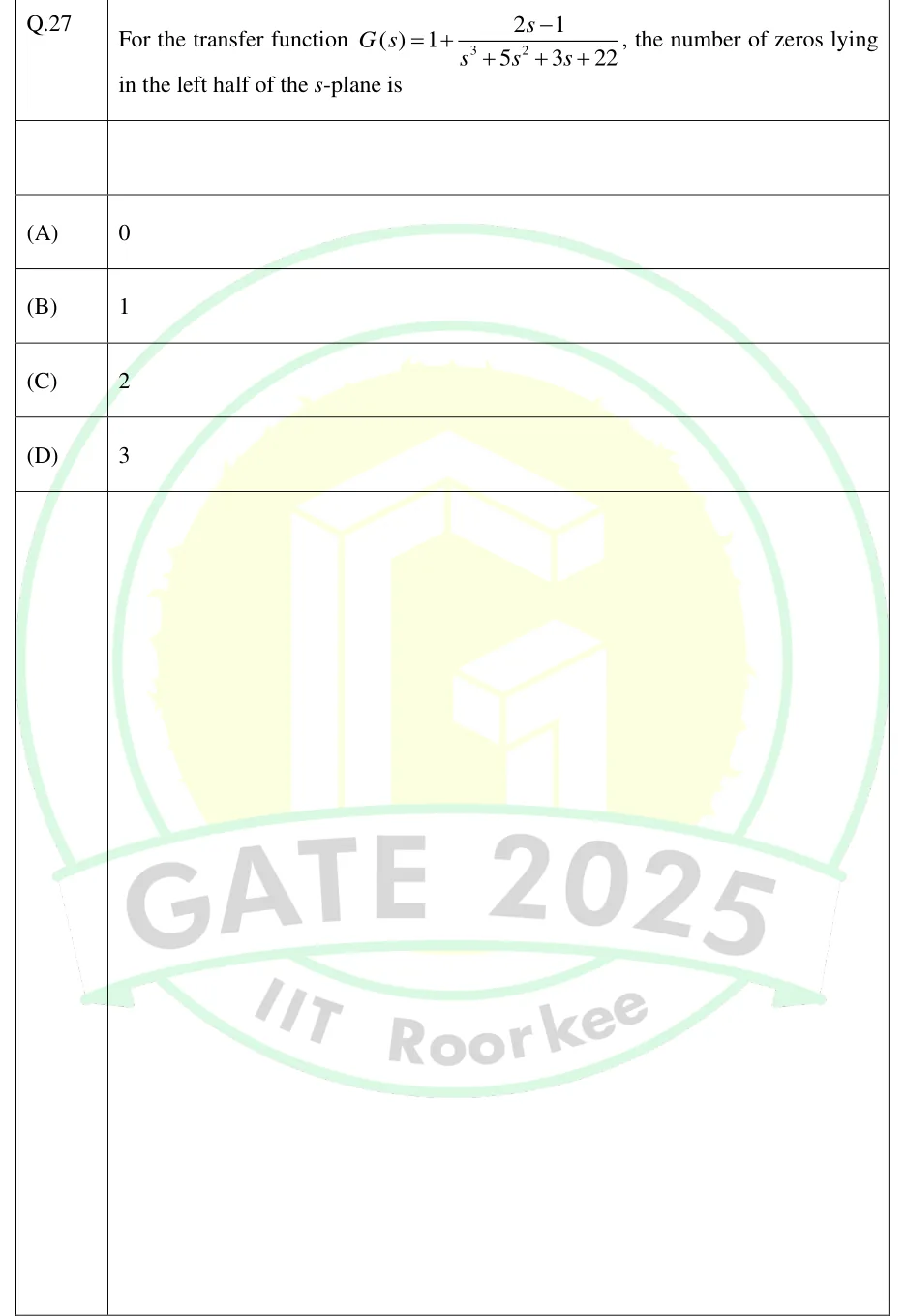
For the transfer function , the number of zeros lying in the left half of the -plane is
- (A)
0
- (B)
1
- (C)
2
- (D)
3

For the transfer function , the number of zeros lying in the left half of the -plane is
0
1
2
3
ANSWER
All three zeros of , the roots of , lie in the left half of the -plane. Answer: (D) 3.
Official answer: DSource: Official answer key, GATE 2025 IN (IIT Roorkee)
Put over one denominator:
The zeros of are the roots of the combined numerator . They are not the root of , which is only the numerator of the second term.
Check for pole-zero cancellation. , so a common root would have to be . But . Nothing cancels, so all three zeros remain.
Routh array for :
The first column is all positive. There are no sign changes and no zero rows, so has no roots in the right half-plane and none on the axis.
So all 3 zeros lie in the left half of the -plane. (Numerical check: one real zero at about and a complex pair at about .) Answer: (D) 3.
KEY IDEA
Because of the leading , you first have to rewrite as a single fraction. Its zeros are then the roots of . Apply the Routh criterion to that combined numerator, not to the denominator. For a cubic with all coefficients positive, every root is in the left half-plane exactly when . Here , so all three zeros are in the LHP.
WATCH OUT FOR
Reading the zeros off the term gives a single zero at , which leads to the wrong answer (A) 0. A second mistake is running the Routh test on the denominator . That polynomial gives the poles, not the zeros: its entry is , so it has two right-half-plane roots, and this can mislead you into picking (B) 1.
From the GATE 2025 IN paper. Every question of this paper · Download the full paper · All 15 Routh–Hurwitz questions, with notes