
IAE Academy

GATE 2018 IN Q.13: solution and answer

GATE 2018 · INQ.13 · 1 mark · MCQ

The approximate phase response of is
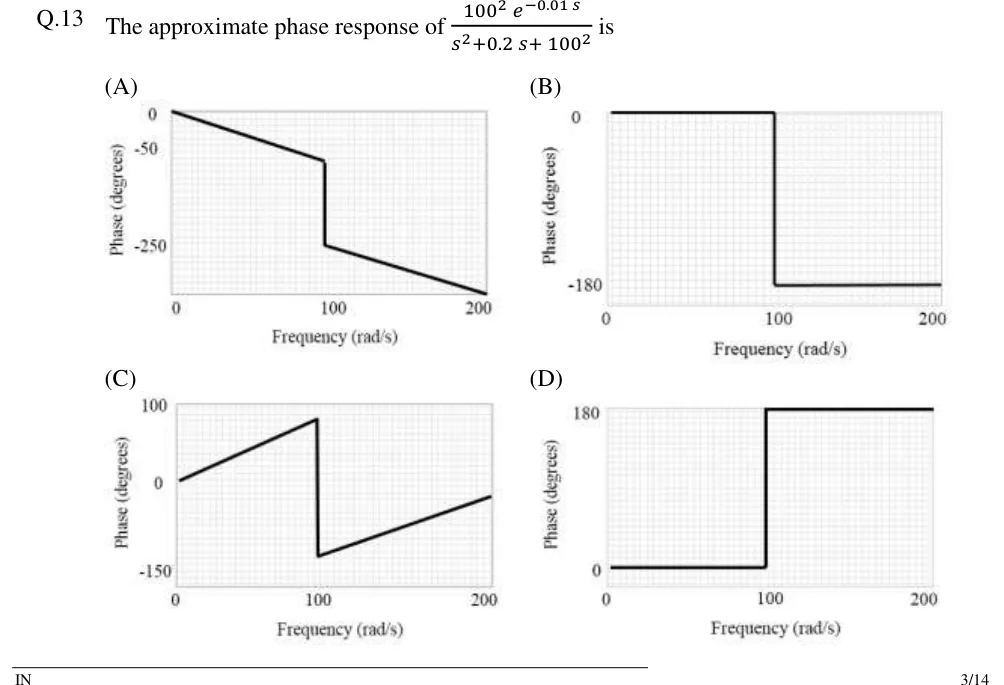
GATE 2018 IN question 13: All four options are phase plots.Tap to open full size
Figure from the GATE 2018 IN paper. It is part of the question.
Figure description

All four options are phase plots. In each one the horizontal axis is Frequency (rad/s) running from 0 to 200, with a tick label at 100, and the vertical axis is Phase (degrees). (A) Axis labels at 0, -50 and -250. The labels are not evenly spaced: the gap from 0 to -50 is about a third of the gap from -50 to -250. So the plot is a sketch, not a scaled graph. A straight line falls from (0, 0) to a corner just below 100 rad/s, a little below the -50 label (roughly -70 degrees on the printed labels). There the phase drops vertically to the level of the -250 label. It then falls in a straight line with the same slope as the first segment, reaching the bottom edge of the plot at 200 rad/s (roughly -345 degrees on the printed labels). (B) Axis labels at 0 and -180. The phase is flat at 0 from 0 to 100 rad/s, steps down vertically to -180 at 100 rad/s, and stays flat at -180 out to 200 rad/s. (C) Axis labels at 100, 0 and -150. A straight line rises from (0, 0) to about +80 degrees at 100 rad/s. It drops vertically to about -120 degrees (above the -150 label), then rises in a straight line to about -20 degrees at 200 rad/s. (D) Axis labels at 0 and 180. The phase is flat at 0 from 0 to 100 rad/s, steps up vertically to +180 at 100 rad/s, and stays flat at +180 out to 200 rad/s.

  1. (A)

    Figure: phase falls in a straight line from 0 to a little below the -50 label just before 100 rad/s, drops vertically to the -250 label, then keeps falling with the same slope to the bottom of the plot at 200 rad/s.

  2. (B)

    Figure: phase is flat at 0 up to 100 rad/s, steps down to -180 degrees and stays flat there out to 200 rad/s.

  3. (C)

    Figure: phase rises linearly from 0 to about +80 degrees at 100 rad/s, drops vertically to about -120 degrees, then rises linearly to about -20 degrees at 200 rad/s.

  4. (D)

    Figure: phase is flat at 0 up to 100 rad/s, steps up to +180 degrees and stays flat there out to 200 rad/s.

Answer and solution

ANSWER

The answer is (A). The phase is the delay's straight line, degrees, with an almost vertical drop at caused by the nearly undamped poles.

Official answer: ASource: Official answer key, GATE 2018 IN (IIT Guwahati)

  1. Split the phase into two parts. When factors are multiplied, their phases add. The constant in the numerator adds nothing.

  2. Match the quadratic to the standard form . This gives and , so . The poles are almost undamped.

  3. Phase of the quadratic. At the denominator is . Its imaginary part is always positive. Its real part changes sign at . So The phase passes at and at . The whole fall therefore happens within about . On a 0 to 200 rad/s axis that is a vertical downward step at .

  4. Phase of the pure delay. , but . With , degrees. This is a straight line through the origin with a negative slope, and it continues on both sides of 100 rad/s.

  5. Add the two parts at the key frequencies:

  6. So the phase has three parts: a falling straight line, a downward drop at 100 rad/s, and then a falling line with the same slope. Option (A) is the only plot with this shape. Its axis labels are not evenly spaced, so it is a sketch and its corner values cannot be read off it. The shape identifies it.

  7. Rule out the others. (B) and (D) are flat except for the step, so they leave out the delay's linear phase lag. (D) also steps up to . Tracked continuously, the phase of a pair of left-half-plane poles moves from down to , never up. (C) has a rising slope, which would need a lead term instead of a delay.

KEY IDEA

When factors are multiplied, their phases add. A pure delay has magnitude 1 but phase , which is a straight falling line on a linear frequency axis. A second-order pair with has a phase that jumps almost vertically from to at . The answer is the delay's line with a step cut into it at .

WATCH OUT FOR

The most common mistake is leaving out the delay because , which leads to (B). The delay's magnitude is 1, but its phase is not zero. Two other slips: taking the delay's phase as , which gives the rising slope of (C); and evaluating on a calculator above . There the denominator is negative, so the angle lies in the second quadrant and the phase is near , not near .

From the GATE 2018 IN paper. Every question of this paper · Download the full paper · All 27 Bode & margins questions, with notes

More Bode & margins questions