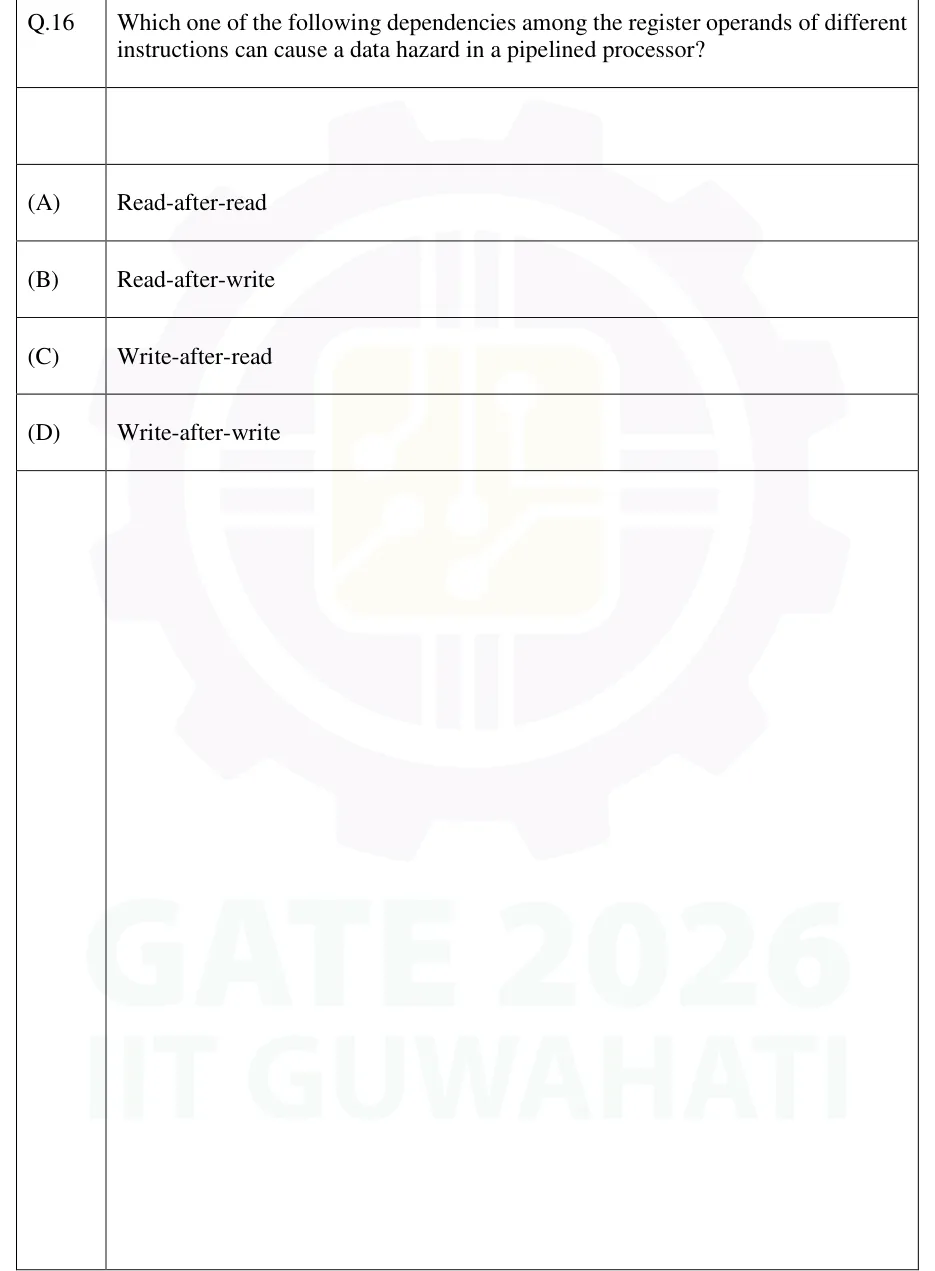
Which one of the following dependencies among the register operands of different instructions can cause a data hazard in a pipelined processor?
- (A)
Read-after-read
- (B)
Read-after-write
- (C)
Write-after-read
- (D)
Write-after-write

Which one of the following dependencies among the register operands of different instructions can cause a data hazard in a pipelined processor?
Read-after-read
Read-after-write
Write-after-read
Write-after-write
ANSWER
The correct answer is (B) Read-after-write.
Official answer: BSource: Official answer key, GATE 2026 CS1 (IIT Guwahati)
A data hazard occurs when overlapping (pipelined) execution of instructions can change the outcome relative to strictly sequential execution, due to a dependency through a shared register operand.
Read-after-read (RAR): both instructions only read the register. Reads don't change the register's value, so the order in which they read it doesn't matter — no hazard.
Write-after-read (WAR) and write-after-write (WAW): in a simple single-issue, in-order pipeline, every instruction reads its operands (ID stage) and writes its result (WB stage) strictly in program order, so a later instruction can never overtake an earlier one's read or write. WAR/WAW can only cause trouble under out-of-order or overlapped-write execution, not in this standard in-order pipeline — so they are not the answer here.
Read-after-write (RAW): a later instruction needs to read a register that an earlier instruction has not yet finished computing/writing. If the read (in ID) happens before the earlier instruction's write (in WB) has completed, the pipeline reads a stale value — producing a wrong result unless stalled or the value is forwarded. This is a genuine data hazard even in a simple in-order pipeline.
Since RAW is the only one of the four dependencies that can actually corrupt a result under ordinary in-order pipelined execution, it is the dependency that causes a data hazard.
Hence the answer is Read-after-write, option (B).
KEY IDEA
In a simple in-order pipeline, only a true (flow) dependency — a later instruction reading a register before an earlier instruction has finished writing it — can produce an incorrect result; this is the Read-After-Write (RAW) hazard.
WATCH OUT FOR
Confusing RAW (a true data dependency that causes a real hazard even in a simple in-order pipeline) with WAR/WAW (anti- and output-dependencies, which only matter under out-of-order or overlapped-write execution) — or picking RAR by mistakenly treating any repeated access as hazardous.
From the GATE 2026 CS1 paper. Every question of this paper · Download the full paper · All 12 Pipelining questions, with notes