
IAE Academy

GATE 2024 CS1 Q.15: solution and answer

GATE 2024 · CS1Q.15 · 1 mark · MCQ

Which one of the following statements is FALSE?

  1. (A)

    In the cycle stealing mode of DMA, one word of data is transferred between an I/O device and main memory in a stolen cycle

  2. (B)

    For bulk data transfer, the burst mode of DMA has a higher throughput than the cycle stealing mode

  3. (C)

    Programmed I/O mechanism has a better CPU utilization than the interrupt driven I/O mechanism

  4. (D)

    The CPU can start executing an interrupt service routine faster with vectored interrupts than with non-vectored interrupts
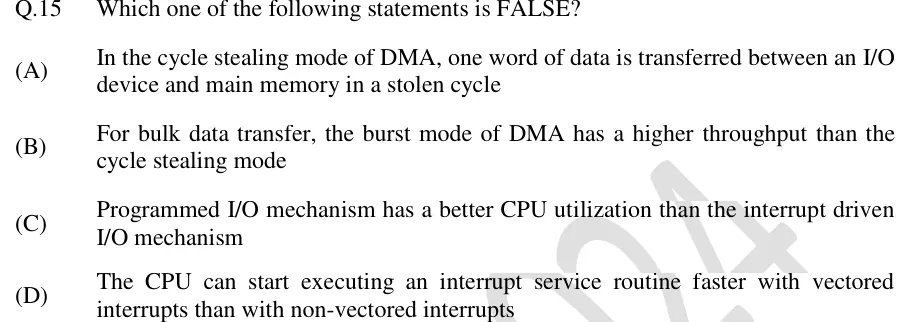
See the question in the paper

Answer and solution

ANSWER

Statement (C) is the FALSE one: Programmed I/O does not have better CPU utilization than interrupt-driven I/O — it has worse, because the CPU busy-waits.

Official answer: CSource: Official answer key, GATE 2024 CS1 (IISc Bengaluru)

  1. Statement (A): In cycle stealing DMA, the DMA controller steals one bus cycle at a time from the CPU, and in that single stolen cycle exactly one word is transferred between the I/O device and main memory. This is the standard definition of cycle stealing, so (A) is TRUE.

  2. Statement (B): Burst mode DMA acquires the system bus and holds it for the entire block transfer, moving all words consecutively without releasing the bus between words; cycle stealing mode gives the bus back to the CPU after every single word, incurring repeated arbitration overhead. For bulk (block) data transfer this makes burst mode's throughput higher than cycle stealing mode's, so (B) is TRUE.

  3. Statement (C): Programmed I/O forces the CPU into a busy-wait polling loop, continuously testing the device's status flag and doing no other useful work while waiting — this is 100% CPU time spent waiting. Interrupt-driven I/O instead lets the CPU execute other instructions and is only interrupted when the device becomes ready, so it uses CPU cycles far more productively. Therefore interrupt-driven I/O has BETTER CPU utilization than programmed I/O — the reverse of what (C) claims. So (C) is FALSE.

  4. Statement (D): With vectored interrupts, the interrupting device (or dedicated hardware) supplies the address/vector of its ISR directly, so the CPU jumps straight to the correct ISR. With non-vectored interrupts, the CPU must first execute a polling routine or read a fixed common address to work out which device interrupted, before it can locate and start the correct ISR. This extra identification step delays ISR execution under non-vectored interrupts, so vectored interrupts let the CPU start executing the ISR faster, making (D) TRUE.

  5. Exactly one statement must be false; (A), (B), and (D) all hold under standard DMA/interrupt theory, while (C) inverts the well-known CPU-utilization ordering (interrupt-driven I/O > programmed I/O). Hence the false statement is (C).

KEY IDEA

Compare each option against standard I/O/DMA facts: cycle stealing (one word per stolen cycle), burst mode (higher throughput than cycle stealing for bulk transfer), programmed I/O (CPU busy-waits, so WORSE utilization than interrupt-driven I/O — this inverts the fact, making it the false statement), and vectored interrupts (faster ISR dispatch than non-vectored, which needs a polling/query sequence).

WATCH OUT FOR

Confusing "faster/simpler to implement" with "better CPU utilization" — programmed I/O is simpler but wastes CPU cycles polling, so it has WORSE utilization than interrupt-driven I/O, not better.

From the GATE 2024 CS1 paper. Every question of this paper · Download the full paper · All 8 I/O, interrupts & DMA questions, with notes

More I/O, interrupts & DMA questions