IAE Academy

GATE 2018 CS Q.14: solution and answer

GATE 2018 · CSQ.14 · 1 mark · MCQ

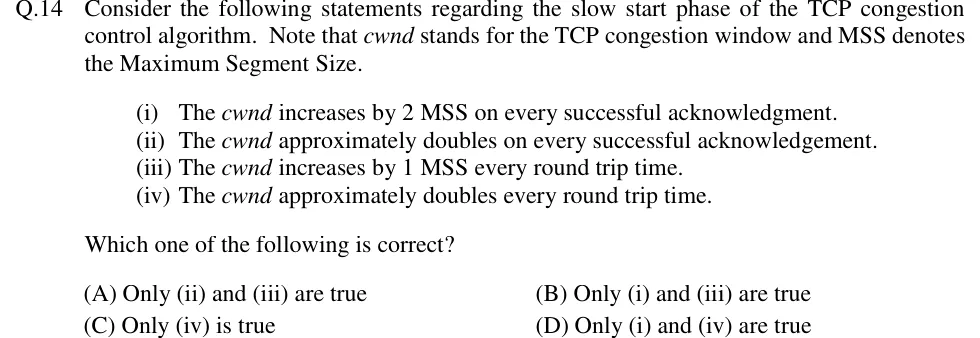
Consider the following statements regarding the slow start phase of the TCP congestion control algorithm. Note that cwnd stands for the TCP congestion window and MSS denotes the Maximum Segment Size.

(i) The cwnd increases by 2 MSS on every successful acknowledgment.
(ii) The cwnd approximately doubles on every successful acknowledgement.
(iii) The cwnd increases by 1 MSS every round trip time.
(iv) The cwnd approximately doubles every round trip time.

Which one of the following is correct?

  1. (A)

    Only (ii) and (iii) are true

  2. (B)

    Only (i) and (iii) are true

  3. (C)

    Only (iv) is true

  4. (D)

    Only (i) and (iv) are true

See the question in the paper

Answer and solution

ANSWER

Option C: only (iv) is true.

Official answer: CSource: Official answer key, GATE 2018 CS (IIT Guwahati)

  1. In slow start, each new acknowledgment for a full segment raises by . Statement (i) says 2 MSS per acknowledgment, so (i) is false.

  2. Statement (ii) says doubles on every acknowledgment. One acknowledgment adds only 1 MSS, so goes from to and does not double. Statement (ii) is false.

  3. Take a window of segments. In one round trip time about acknowledgments return, and each adds 1 MSS. After one round trip time the window is .

  4. So goes MSS in successive round trip times, which is exponential growth. Statement (iv) is true.

  5. Statement (iii) says growth of 1 MSS per round trip time. That is the congestion avoidance (additive increase) rule, not slow start. Statement (iii) is false.

  6. Only (iv) is true, so the answer is option C.

KEY IDEA

In TCP slow start, cwnd grows by 1 MSS per acknowledgment, so it roughly doubles every round trip time (exponential growth per RTT, not per ACK).

WATCH OUT FOR

Confusing per-ACK growth with per-RTT growth, or taking the congestion-avoidance rule of +1 MSS per RTT as slow start behaviour.

From the GATE 2018 CS paper. Every question of this paper · Download the full paper · All 12 TCP questions, with notes

More TCP questions