IAE Academy

GATE 2025 CS2 Q.17: solution and answer

GATE 2025 · CS2Q.17 · 1 mark · MCQ

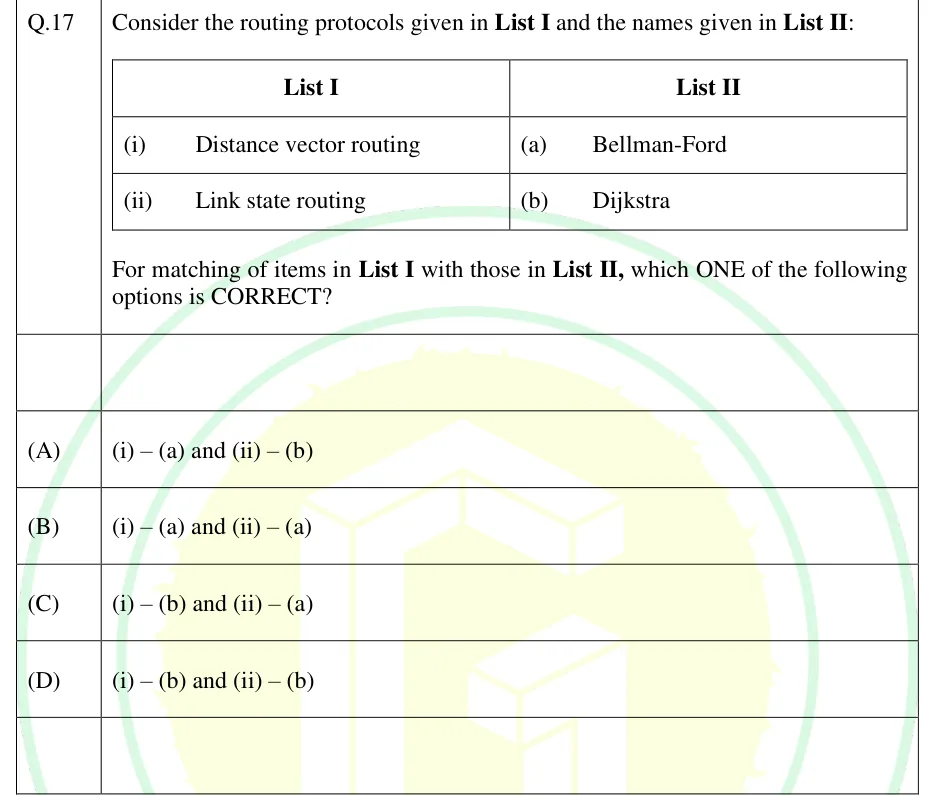
Consider the routing protocols given in List I and the names given in List II:

For matching of items in List I with those in List II, which ONE of the following options is CORRECT?

  1. (A)

    (i) – (a) and (ii) – (b)

  2. (B)

    (i) – (a) and (ii) – (a)

  3. (C)

    (i) – (b) and (ii) – (a)

  4. (D)

    (i) – (b) and (ii) – (b)

See the question in the paper

Answer and solution

ANSWER

Option (A): distance vector routing uses Bellman-Ford, and link state routing uses Dijkstra's algorithm.

Official answer: ASource: Official answer key, GATE 2025 CS2 (IIT Roorkee)

  1. Distance vector routing: each router keeps a vector of its estimated distances to every destination and updates it using the vectors received from its neighbours. This is the distributed form of the Bellman-Ford equation , where runs over the neighbours of . So (i) matches (a).

  2. Link state routing: each router floods the costs of its own links, so every router builds the full network topology. Each router then runs Dijkstra's shortest-path algorithm on that graph. So (ii) matches (b).

  3. The matching is (i) - (a) and (ii) - (b), which is option (A). Options (B), (C) and (D) each pair at least one protocol with the wrong algorithm.

KEY IDEA

Distance vector routing is the distributed Bellman-Ford algorithm, where routers exchange distance vectors with neighbours only. Link state routing floods link costs so every router knows the whole map, then runs Dijkstra locally.

WATCH OUT FOR

Swapping the pairs. Dijkstra needs the whole graph, which only link state provides. Distance vector routers see only their neighbours' vectors, which is exactly the situation Bellman-Ford handles.

From the GATE 2025 CS2 paper. Every question of this paper · Download the full paper · All 3 Routing questions, with notes

More Routing questions