
IAE Academy

GATE 2023 CS Q.25: solution and answer

GATE 2023 · CSQ.25 · 1 mark · MSQ

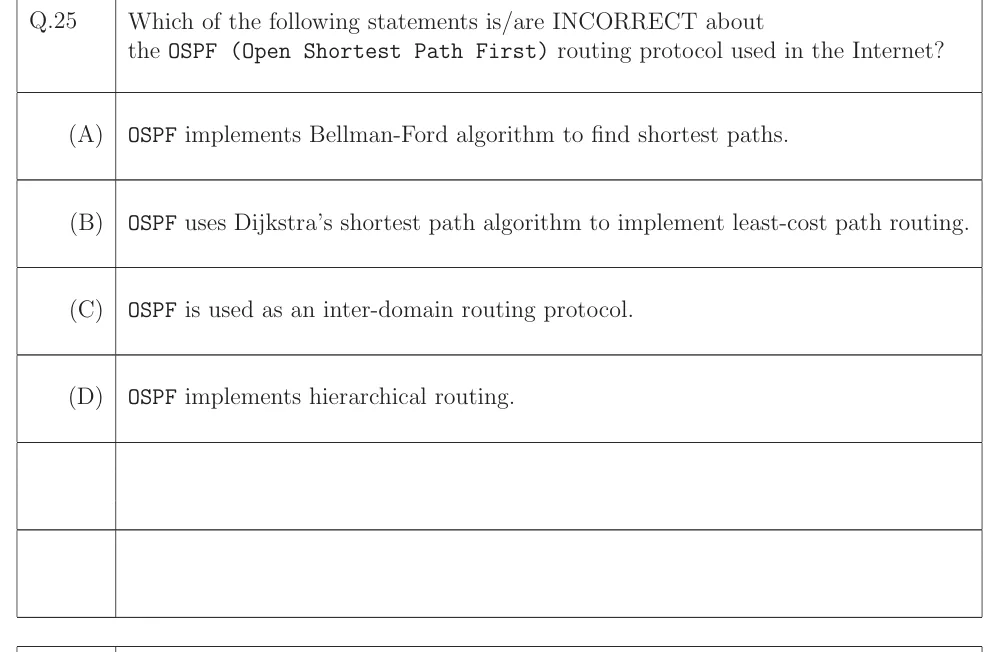
Which of the following statements is/are INCORRECT about the OSPF (Open Shortest Path First) routing protocol used in the Internet?

  1. (A)

    OSPF implements Bellman-Ford algorithm to find shortest paths.

  2. (B)

    OSPF uses Dijkstra's shortest path algorithm to implement least-cost path routing.

  3. (C)

    OSPF is used as an inter-domain routing protocol.

  4. (D)

    OSPF implements hierarchical routing.
See the question in the paper

Answer and solution

ANSWER

The incorrect statements are (A) and (C).

Official answer: A, CSource: Official answer key, GATE 2023 CS (IIT Kanpur)

  1. OSPF is a link-state protocol. Each router floods link-state advertisements, so every router in an area builds the same topology database.

  2. Each router then runs Dijkstra's shortest path algorithm on that database to compute least-cost routes. So (B) is a correct statement.

  3. Bellman-Ford is the distance-vector algorithm, used by RIP. OSPF does not use it. So (A) is an INCORRECT statement.

  4. OSPF is an interior gateway protocol (IGP) that runs inside one autonomous system. Routing between autonomous systems (inter-domain routing) is done by BGP. So (C) is an INCORRECT statement.

  5. OSPF divides an autonomous system into areas joined through the backbone area 0. This is hierarchical routing. So (D) is a correct statement.

  6. The question asks for the INCORRECT statements, which are (A) and (C).

KEY IDEA

OSPF is an interior, link-state protocol. It runs Dijkstra's algorithm on a link-state database and uses areas around a backbone for hierarchy. Bellman-Ford belongs to distance-vector protocols such as RIP, and inter-domain routing belongs to BGP.

WATCH OUT FOR

Picking the correct statements instead of the incorrect ones, because the question asks for INCORRECT. Another slip is confusing OSPF with BGP and calling it an inter-domain protocol.

From the GATE 2023 CS paper. Every question of this paper · Download the full paper · All 3 Routing questions, with notes