IAE Academy

ISRO CS 2023 Q.14: solution and answer

ISRO 2023 · CSQ.14 · 1 mark · MCQ

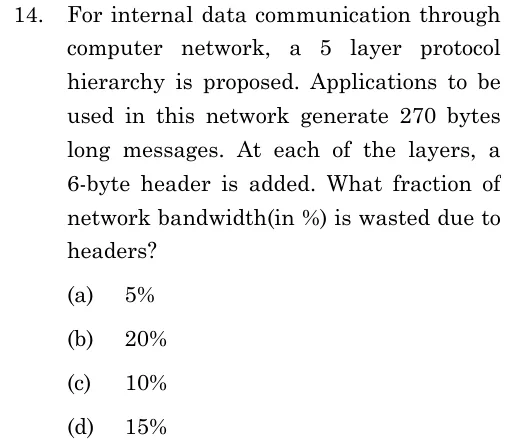
For internal data communication through computer network, a 5 layer protocol hierarchy is proposed. Applications to be used in this network generate 270 bytes long messages. At each of the layers, a 6-byte header is added. What fraction of network bandwidth (in %) is wasted due to headers?

  1. (A)

    5%

  2. (B)

    20%

  3. (C)

    10%

  4. (D)

    15%

See the question in the paper

Answer and solution

ANSWER

The headers waste of the network bandwidth, which is option (c).

Official answer: CSource: ISRO's revised and final answer key of 16 February 2024

  1. In a layered protocol stack, a message passes down through every layer, and each layer adds its own header. With 5 layers and a 6-byte header at each layer, the headers add up to bytes.

  2. The application message is bytes. The total sent on the network per message is bytes.

  3. The bandwidth used by headers is the share of the transmitted bytes that are headers:

  4. The useful payload is the 270-byte message. The overhead is measured against the total transmitted size of 300 bytes, because bandwidth is consumed by everything on the wire.

  5. Checking the other options: would correspond to bytes of header (about 2.5 headers), and and would need and header bytes. None of these follows from five 6-byte headers. Dividing by the payload instead gives , which is not an option either.

KEY IDEA

Every layer adds its own header, so the overhead is (number of layers x header size). Wasted bandwidth is that overhead divided by the total bytes transmitted (payload plus headers).

WATCH OUT FOR

Dividing the header bytes by the payload, , instead of by the total transmitted size, . Another slip is counting only one 6-byte header and answering .

From the ISRO CS 2023 paper. Every question of this paper · The full paper (PDF, ISRO) · All 2 ISRO Layering & switching questions, with notes