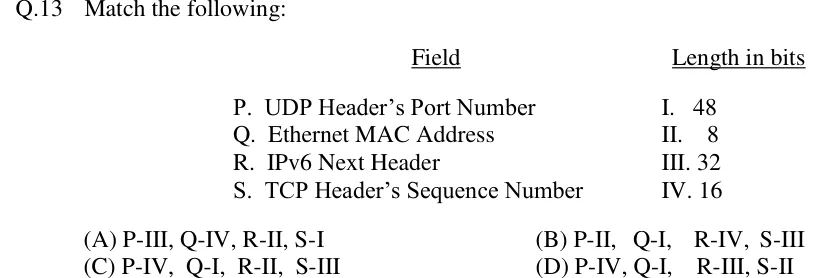
Match the following:
- (A)
P-III, Q-IV, R-II, S-I
- (B)
P-II, Q-I, R-IV, S-III
- (C)
P-IV, Q-I, R-II, S-III
- (D)
P-IV, Q-I, R-III, S-II

Match the following:
P-III, Q-IV, R-II, S-I
P-II, Q-I, R-IV, S-III
P-IV, Q-I, R-II, S-III
P-IV, Q-I, R-III, S-II
ANSWER
The correct matching is P-IV, Q-I, R-II, S-III, which is option (C).
Official answer: CSource: Official answer key, GATE 2018 CS (IIT Guwahati)
A UDP header has 16-bit source and destination port numbers (0 to 65535), so P matches IV (16).
An Ethernet MAC address is 6 bytes, which is 48 bits, so Q matches I (48).
The IPv6 Next Header field is 8 bits wide. It carries a protocol number such as 6 for TCP or 17 for UDP, so R matches II (8).
The TCP sequence number field is 32 bits wide, so S matches III (32).
The matching is P-IV, Q-I, R-II, S-III, which is option (C). Option (A) has P as 32 bits and Q as 16 bits. Option (B) has P as 8 bits. Option (D) has R as 32 bits and S as 8 bits. All three are wrong.
KEY IDEA
Remember the standard field widths. UDP port is 16 bits, Ethernet MAC is 48 bits, IPv6 Next Header is 8 bits and TCP sequence number is 32 bits.
WATCH OUT FOR
Mixing up the IPv6 Next Header (8 bits) with the 32-bit TCP sequence number. Another slip is treating the UDP port as 8 or 32 bits instead of 16.
From the GATE 2018 CS paper. Every question of this paper · Download the full paper · All 2 Layering & switching questions, with notes