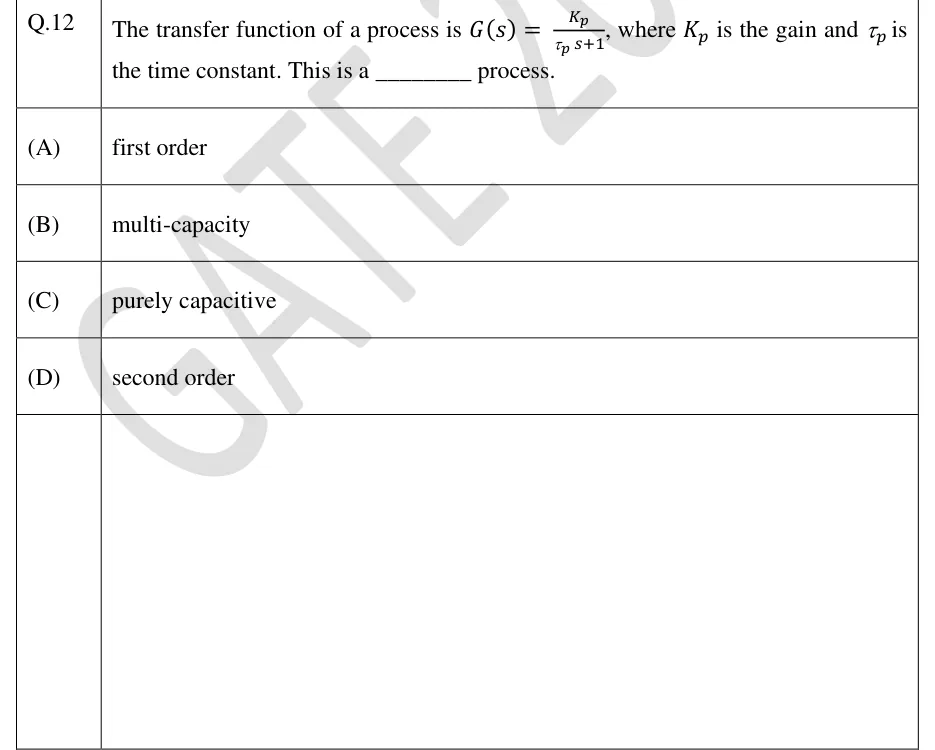
The transfer function of a process is , where is the gain and is the time constant. This is a ________ process.
- (A)
first order
- (B)
multi-capacity
- (C)
purely capacitive
- (D)
second order

The transfer function of a process is , where is the gain and is the time constant. This is a ________ process.
first order
multi-capacity
purely capacitive
second order
ANSWER
(A) first order. The denominator is of degree 1 in , so the process follows the first-order ODE .
Official answer: ASource: Official answer key, GATE 2024 BT (IISc Bengaluru)
The order of a process is the highest power of in the denominator of its transfer function. That is also the order of the differential equation the transfer function comes from. Here the denominator has degree 1.
Take the inverse Laplace transform, with and as deviation variables and zero initial conditions: . This is a first-order linear ODE. is the steady-state gain (output units per input unit) and is the time constant (in or ).
The single pole is at . A time constant is positive, so this is one real negative pole and the process is self-regulating. A step of size gives , which reaches 63.2% of its final value at .
Why not (C): a purely capacitive (integrating) process has . Its pole is at and there is no constant term in the denominator, so after a step its output ramps without bound. The in makes the output settle instead. Physically this is a single capacity with a resistance, such as a tank draining through a valve.
Why not (B) or (D): a multi-capacity process is two or more first-order lags in series, , so its denominator has degree 2 or more. A second-order process has an term, , where is the damping ratio. The given denominator is only of degree 1, so it is neither.
So the process is first order: option (A).
KEY IDEA
A process's order is the highest power of in its transfer-function denominator. is the standard first-order lag: one pole at , and its step response settles at after reaching 63.2% of that value at .
WATCH OUT FOR
Calling it "purely capacitive" because a single tank is a capacity. A purely capacitive (integrating) process is , with no term and a pole at the origin, and its output ramps without bound after a step. is a capacity with a resistance, and its output settles.
From the GATE 2024 BT paper. Every question of this paper · Download the full paper · All 9 Process control questions, with notes