IAE Academy

GATE 2020 BT Q.8: solution and answer

GATE 2020 · BTQ.8 · 1 mark · MCQ

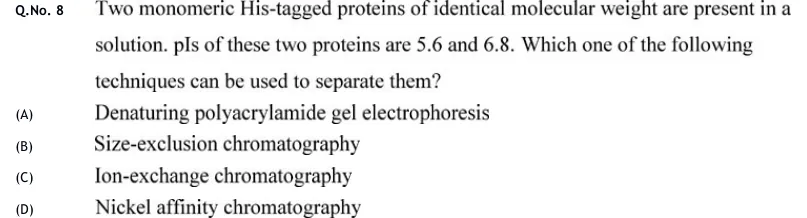
Two monomeric His-tagged proteins of identical molecular weight are present in a solution. pIs of these two proteins are 5.6 and 6.8. Which one of the following techniques can be used to separate them?

  1. (A)

    Denaturing polyacrylamide gel electrophoresis

  2. (B)

    Size-exclusion chromatography

  3. (C)

    Ion-exchange chromatography

  4. (D)

    Nickel affinity chromatography

See the question in the paper

Answer and solution

ANSWER

(C) Ion-exchange chromatography. The two proteins differ only in pI (5.6 vs 6.8), so at a pH between the two they carry opposite net charges and can be separated on an ion exchanger.

Official answer: CSource: Official answer key, GATE 2020 BT (IIT Delhi)

  1. What differs between the two proteins? Both are monomers, both have the same molecular weight, and both carry a His-tag. The only property that differs is the isoelectric point (pI, the pH at which a protein's net charge is zero): for one and for the other.

  2. (A) Denaturing SDS-PAGE: SDS unfolds each chain and coats it with negative charge roughly in proportion to its length, which swamps the protein's own charge. The chains therefore separate by size alone. With identical molecular weights, the two proteins run as a single band. Rejected.

  3. (B) Size-exclusion chromatography: this separates by hydrodynamic size. Two monomers of the same mass elute at essentially the same volume. Rejected.

  4. (D) Nickel affinity chromatography (IMAC): immobilised binds the His-tag, and both proteins carry one. They bind together and elute together with imidazole. This step purifies them away from untagged proteins but does not separate them from each other. Rejected.

  5. (C) Ion-exchange chromatography: a protein's net charge depends on the buffer pH relative to its pI. The net charge is positive when and negative when . Proteins with different pIs therefore carry different net charges at the same pH.

  6. Choosing a working pH: use a buffer at about , between the two pIs. The protein with is net negative and binds an anion exchanger (for example DEAE or Q). The protein with is net positive and flows through. A salt or pH gradient then elutes the bound protein on its own.

  7. Answer: only ion-exchange chromatography uses the -unit pI difference, so the answer is option (C).

KEY IDEA

Match the separation technique to the one property that differs. Here size and mass are equal and both proteins carry the same His-tag, so size-based methods (SDS-PAGE, size exclusion) and tag-based affinity (Ni-IMAC) cannot tell them apart. Only charge differs: at a buffer pH between the two pIs, one protein is net negative and the other net positive, which is exactly what ion exchange separates.

WATCH OUT FOR

Picking nickel affinity chromatography because the proteins are His-tagged. IMAC captures every His-tagged protein, so both bind and elute together. It separates tagged from untagged proteins, not two tagged proteins from each other. A second trap is thinking SDS-PAGE separates by charge. SDS masks the native charge, so separation is by size only.

From the GATE 2020 BT paper. Every question of this paper · Download the full paper · All 9 Downstream questions, with notes

More Downstream questions