
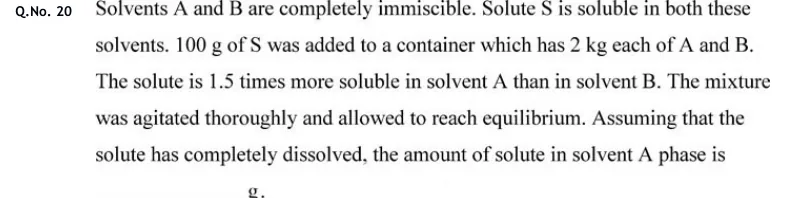
Solvents A and B are completely immiscible. Solute S is soluble in both these solvents. 100 g of S was added to a container which has 2 kg each of A and B. The solute is 1.5 times more soluble in solvent A than in solvent B. The mixture was agitated thoroughly and allowed to reach equilibrium. Assuming that the solute has completely dissolved, the amount of solute in solvent A phase is ________ g.
GATE 2020 BT Q.20: solution and answer
Answer and solution
ANSWER
At equilibrium, solvent phase A holds 60 g of the solute (and phase B holds 40 g).
Official answer: 60Source: Official answer key, GATE 2020 BT (IIT Delhi)
Define the partition (distribution) coefficient , where and are the equilibrium solute concentrations in solvents A and B, in . "1.5 times more soluble in A than in B" gives .
Let g of S end up in phase A. All 100 g dissolves and the solvents are completely immiscible, so phase B holds g.
Concentrations: and . Both phases contain 2 kg of solvent, so the solvent masses cancel.
Equilibrium condition:
Solve: .
Check: phase B holds . Then and , and , as required.
KEY IDEA
In single-stage liquid-liquid extraction between two immiscible solvents, the solute divides so that the ratio of its concentrations follows the partition coefficient: . Combine that with a mass balance on the solute. When the two solvent masses are equal, the solute masses themselves come out in the ratio , here , so A gets .
WATCH OUT FOR
Reading "1.5 times more soluble" as (that is, ). That gives , which is wrong: GATE means . A second mistake is to give the whole 100 g to the better solvent, or to split it 50:50. A third is to apply to the solute masses when the solvent masses are unequal. That shortcut works here only because both phases hold 2 kg of solvent.
From the GATE 2020 BT paper. Every question of this paper · Download the full paper · All 9 Downstream questions, with notes
More Downstream questions
- GATE 2026 BT Q.19 · MCQ · 1 markWhich one of the following proteins would elute third in gel filtration chromatography from a mixture of…
- GATE 2025 BT Q.23 · MSQ · 1 markWhich of the following separation processes is/are based on molecular size?
- GATE 2025 BT Q.27 · MSQ · 1 markA recombinant protein is secreted extracellularly in soluble form by an *E. coli* culture.
- GATE 2024 BT Q.11 · MCQ · 1 markIn adsorption chromatography, the adsorption of uncharged solute molecules onto a silica-based stationary…