
IAE Academy

GATE 2024 BT Q.55: solution and answer

GATE 2024 · BTQ.55 · 2 marks · NAT

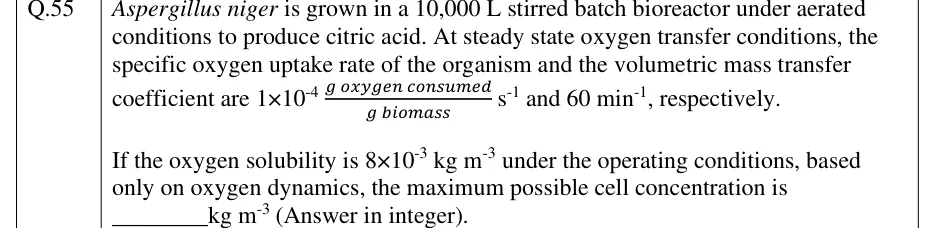
Aspergillus niger is grown in a 10,000 L stirred batch bioreactor under aerated conditions to produce citric acid. At steady state oxygen transfer conditions, the specific oxygen uptake rate of the organism and the volumetric mass transfer coefficient are and , respectively.

If the oxygen solubility is under the operating conditions, based only on oxygen dynamics, the maximum possible cell concentration is ________ (Answer in integer).
See the question in the paper

Answer and solution

ANSWER

The maximum possible cell concentration is 80 kg m^-3.

Official answer: 80Source: Official answer key, GATE 2024 BT (IISc Bengaluru)

  1. At steady state, the rate at which oxygen is transferred into the broth equals the rate at which the cells consume it: . Here is the volumetric mass transfer coefficient, the oxygen solubility (saturation concentration), the dissolved oxygen concentration in the broth, the specific oxygen uptake rate and the cell (biomass) concentration.

  2. The transfer rate is largest when the driving force is largest, i.e. when . So the maximum oxygen transfer rate is , and the largest biomass concentration the aeration can support is .

  3. Put both rates in the same time unit: .

  4. Maximum oxygen transfer rate: .

  5. , which is the same as , because a mass-per-mass ratio does not depend on the mass unit.

  6. The reactor volume (10,000 L) does not enter the answer, because both the transfer rate and the uptake rate are per unit volume of broth.

KEY IDEA

When oxygen supply is the limit, the dissolved oxygen falls to zero and the maximum transfer rate just matches the total uptake . So , with and in the same time unit.

WATCH OUT FOR

Leaving in while is in gives . Converting the wrong way () gives about 1.33. A third slip is multiplying by the 10,000 L volume, which has no place here because both rates are already per unit volume.

From the GATE 2024 BT paper. Every question of this paper · Download the full paper · All 24 Bioreactor operation questions, with notes

More Bioreactor operation questions