
IAE Academy

GATE 2024 DA Q.24: solution and answer

GATE 2024 · DAQ.24 · 1 mark · MCQ

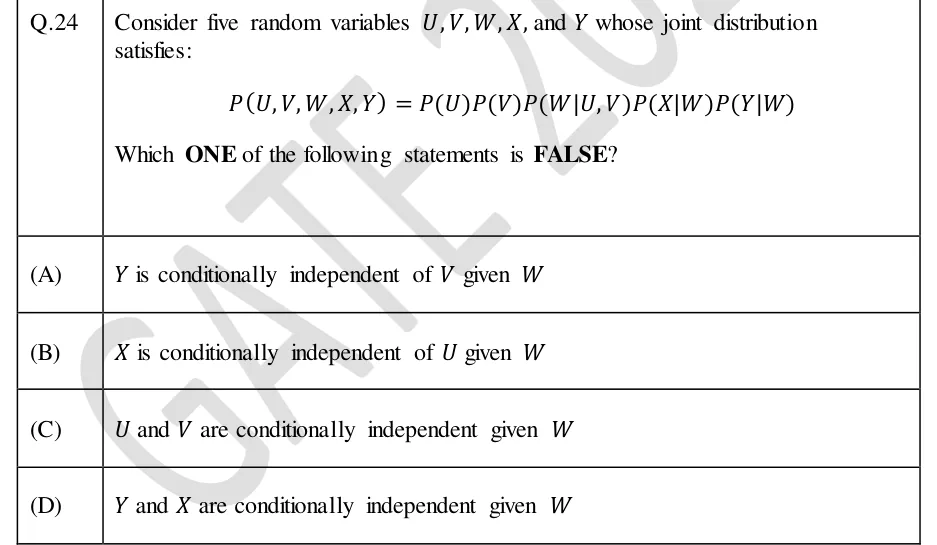
Consider five random variables , and whose joint distribution satisfies:

Which ONE of the following statements is FALSE?

  1. (A)

    is conditionally independent of given

  2. (B)

    is conditionally independent of given

  3. (C)

    and are conditionally independent given
  4. (D)

    and are conditionally independent given

See the question in the paper

Answer and solution

ANSWER

The FALSE statement is (C): and are not conditionally independent given in general.

Official answer: CSource: Official answer key, GATE 2024 DA (IISc Bengaluru)

  1. Read the factorisation as a Bayesian network. Each factor gives edges from parent to child, so the edges are , , and . The statement that is FALSE is the one that d-separation (or direct algebra) does not support.

  2. (A) The only path from to is . Here is a chain (pass-through) node, so conditioning on blocks the path. Hence holds, and (A) is true.

  3. (B) The only path from to is . Again is a chain node, so conditioning on blocks it. Hence holds, and (B) is true.

  4. (D) The only path from to is , where is a common cause (fork). Conditioning on blocks it. Algebraically, , because the factors and do not involve or . So (D) is true.

  5. (C) The path has as a collider. Marginally , so and are independent. Conditioning on a collider opens the path, so and are in general dependent given .

  6. Check with a counterexample. Let be independent fair bits and let , which is allowed because is an arbitrary conditional distribution. Given , we have , so . But . These differ, so .

  7. In general , which factors into a function of times a function of only if itself factors. The network does not guarantee this, so statement (C) is the false one.

KEY IDEA

Read the factorisation as a Bayesian network and apply d-separation. Chains and forks are blocked by conditioning on the middle node, but a collider such as is opened by conditioning on (or on a descendant of it). Marginally independent parents therefore become dependent given the child.

WATCH OUT FOR

Assuming that because and are independent a priori (the factorisation has ), they stay independent once is observed. This ignores the explaining-away effect at a collider.

From the GATE 2024 DA paper. Every question of this paper · Download the full paper · All 3 Uncertainty questions, with notes