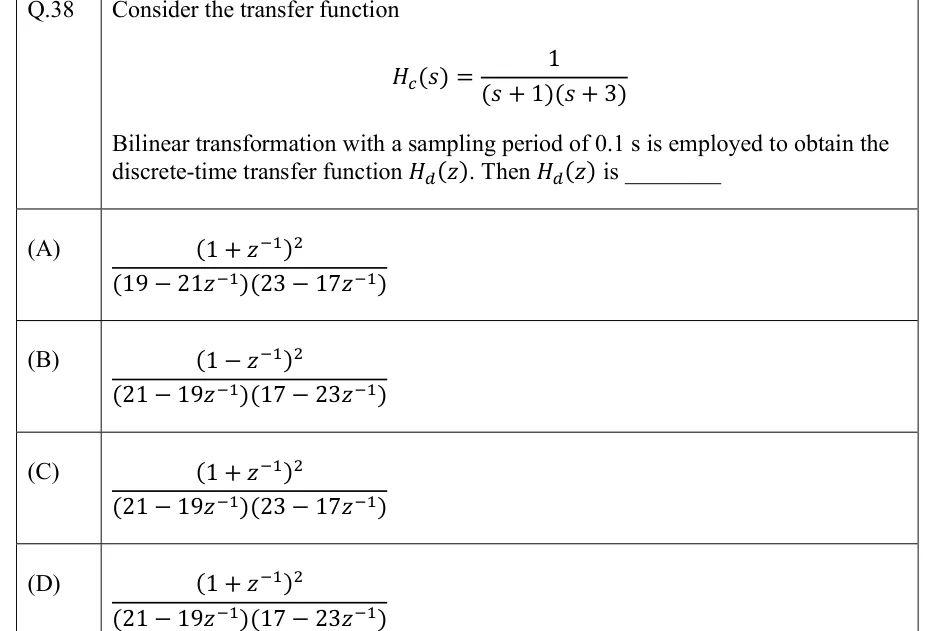
Consider the transfer function
Bilinear transformation with a sampling period of 0.1 s is employed to obtain the discrete-time transfer function . Then is ________
- (A)
- (B)
- (C)
- (D)

Consider the transfer function
Bilinear transformation with a sampling period of 0.1 s is employed to obtain the discrete-time transfer function . Then is ________
ANSWER
The answer is (C): .
Official answer: CSource: Official answer key, GATE 2022 IN (IIT Kharagpur)
Bilinear transformation: . With , , so .
First factor, over the common denominator :
Second factor:
Substitute into . Each denominator factor contributes one in its own denominator, so both move up to the numerator:
DC-gain check: the bilinear map sends to , so must equal . Here , which confirms the result.
Pole check: the bilinear map sends to . The poles and therefore go to and , both inside the unit circle as they must be for a stable . These are exactly the roots of and .
This matches option (C). Option (A) swaps the coefficients of the first factor to (pole at , outside the unit circle; DC gain ). Option (D) flips the second factor to (pole at ; DC gain ). Option (B) has in the numerator, which would make the DC gain zero.
KEY IDEA
Replace by (here ) and write each factor over the common denominator , which gives . Each first-order pole factor puts one in the numerator. You can check the result two quick ways: the DC gain must survive ( matches ), and a stable pole must land inside the unit circle at .
WATCH OUT FOR
Writing the factor as , i.e. swapping the two coefficients. That gives or , which put a pole outside the unit circle and flip the sign of the DC gain (the traps in options A and D). Another mistake is using without the factor 2, or putting in the numerator (option B).
From the GATE 2022 IN paper. Every question of this paper · Download the full paper · All 2 FIR & IIR filters questions, with notes