IAE Academy

GATE 2019 BT Q.29: solution and answer

GATE 2019 · BTQ.29 · 2 marks · MCQ

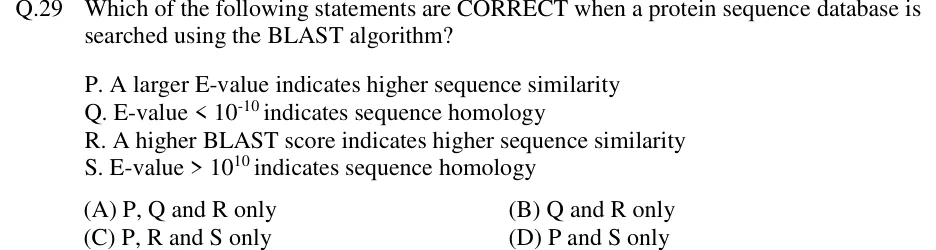
Which of the following statements are CORRECT when a protein sequence database is searched using the BLAST algorithm?

P. A larger E-value indicates higher sequence similarity
Q. E-value < 10^-10 indicates sequence homology
R. A higher BLAST score indicates higher sequence similarity
S. E-value > 10^10 indicates sequence homology

  1. (A)

    P, Q and R only

  2. (B)

    Q and R only

  3. (C)

    P, R and S only

  4. (D)

    P and S only

See the question in the paper

Answer and solution

ANSWER

The correct answer is (B) Q and R only.

Official answer: BSource: Official answer key, GATE 2019 BT (IIT Madras)

  1. BLAST's E-value is the expected number of chance alignments with a score at least as good as the one observed in a database of that size; the BLAST score is a direct measure of alignment quality built from substitution-matrix rewards and gap penalties. Smaller E-value = less likely to be chance = higher significance/homology; higher score = better alignment = higher similarity — the two measures move in opposite directions relative to 'better'.

  2. P claims a LARGER E-value indicates higher similarity. This is backwards: a larger E-value means the match is more likely to be a chance occurrence, i.e. lower significance/similarity, not higher. P is FALSE.

  3. Q states E-value < 10^{-10} indicates sequence homology. Such a vanishingly small E-value means the alignment would essentially never be expected by chance, so it strongly indicates true sequence homology. Q is TRUE.

  4. R states a higher BLAST score indicates higher sequence similarity. Since the score accumulates positive contributions for matches/conservative substitutions and is penalized for mismatches and gaps, a higher score directly corresponds to a better, more similar alignment. R is TRUE.

  5. S states E-value > 10^{10} indicates sequence homology. An E-value this large means on the order of 10^{10} equally good chance matches would be expected in the search — this is the signature of NO homology, not evidence for it. S is FALSE.

  6. Only Q and R are correct statements, which is option (B).

KEY IDEA

In BLAST, the E-value is the expected number of alignments of that score or better occurring purely by chance in a database search — so a SMALLER E-value means the match is less likely to be chance, i.e. more significant/homologous. The BLAST score, by contrast, is a direct measure of alignment quality (built from substitution-matrix rewards/penalties for matches, mismatches and gaps): a HIGHER score means a better, more similar alignment. The two measures move in opposite directions relative to "better," which is exactly why this question mixes them.

WATCH OUT FOR

Treating "larger/higher" as uniformly "better" for both quantities — assuming a larger E-value or a higher E-value threshold also signals stronger homology, when only a very small E-value (like P < 10^{-10}) indicates true homology, while a very large E-value (like > 10^{10}) indicates the match is essentially indistinguishable from random chance, i.e. no evidence of homology.

From the GATE 2019 BT paper. Every question of this paper · Download the full paper · All 11 Bioinformatics questions, with notes

More Bioinformatics questions