IAE Academy

ISRO CS 2025 Q.63: solution and answer

ISRO 2025 · CSQ.63 · 1 mark · MCQ

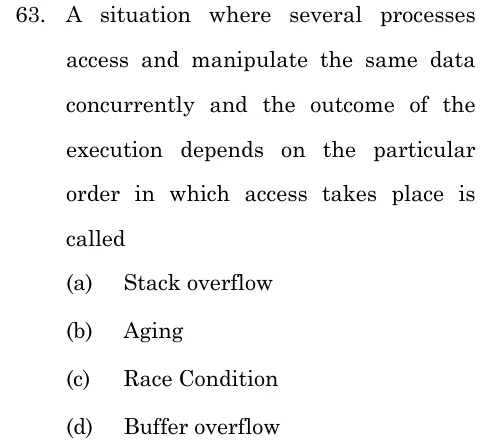
63. A situation where several processes access and manipulate the same data concurrently and the outcome of the execution depends on the particular order in which access takes place is called

  1. (A)

    Stack overflow

  2. (B)

    Aging

  3. (C)

    Race Condition

  4. (D)

    Buffer overflow

See the question in the paper

Answer and solution

ANSWER

The situation described is called a race condition, option (c).

Official answer: CSource: ISRO's final answer key of 15 May 2026

  1. The situation has two features: several processes access and change the same shared data concurrently, and the final result depends on the order in which their accesses are interleaved.

  2. This is the definition of a race condition. For example, two processes each execute counter++. Each one reads the old value, adds 1 and writes it back. If both read before either writes, both write the same new value and one update is lost. A different interleaving gives a different result.

  3. Stack overflow means a process uses more stack space than it was given, for example through very deep recursion. It involves no shared data and no ordering of accesses.

  4. Aging raises the priority of a process that has waited a long time, so that it does not starve. It is a scheduling remedy, not a hazard of concurrent access to shared data.

  5. Buffer overflow means writing past the end of a fixed-size buffer. It is a memory-safety error and does not depend on the order of concurrent accesses.

  6. So the correct option is (c) Race Condition. It is prevented by mutual exclusion (locks, semaphores) around the critical section.

KEY IDEA

When the result of concurrent access to shared data depends on the order in which the accesses interleave, the situation is a race condition. Mutual exclusion around the critical section prevents it.

WATCH OUT FOR

Confusing a race condition with other faults whose names sound like memory or scheduling problems. Stack overflow and buffer overflow are memory errors, and aging is a fix for starvation. None of them depends on the order of concurrent accesses to shared data.

From the ISRO CS 2025 paper. Every question of this paper · The full paper (PDF, ISRO) · All 3 ISRO Synchronisation questions, with notes

More ISRO Synchronisation questions