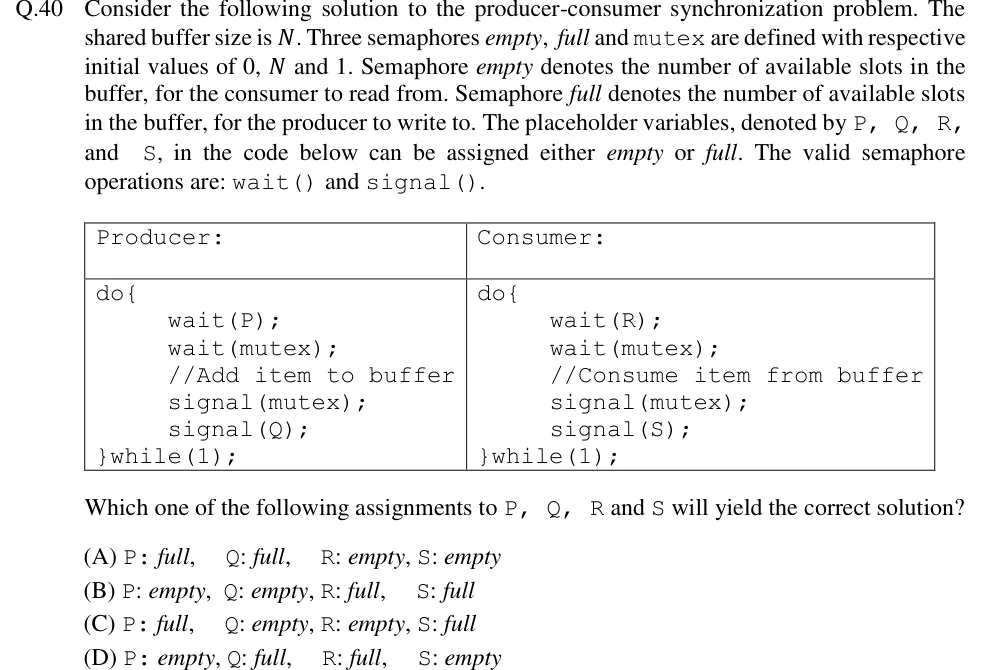
Consider the following solution to the producer-consumer synchronization problem. The shared buffer size is . Three semaphores , and mutex are defined with respective initial values of 0, and 1. Semaphore denotes the number of available slots in the buffer, for the consumer to read from. Semaphore denotes the number of available slots in the buffer, for the producer to write to. The placeholder variables, denoted by P, Q, R, and S, in the code below can be assigned either or . The valid semaphore operations are: wait() and signal().
Producer:
do{
    wait(P);
    wait(mutex);
    //Add item to buffer
    signal(mutex);
    signal(Q);
}while(1);
Consumer:
do{
    wait(R);
    wait(mutex);
    //Consume item from buffer
    signal(mutex);
    signal(S);
}while(1);
Which one of the following assignments to P, Q, R and S will yield the correct solution?
- (A)
P: full, Q: full, R: empty, S: empty
- (B)
P: empty, Q: empty, R: full, S: full
- (C)
P: full, Q: empty, R: empty, S: full
- (D)
P: empty, Q: full, R: full, S: empty