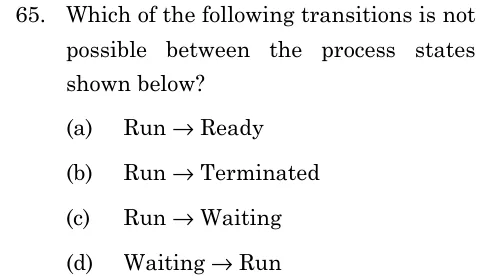
Which of the following transitions is not possible between the process states shown below?
- (A)
Run → Ready
- (B)
Run → Terminated
- (C)
Run → Waiting
- (D)
Waiting → Run

Which of the following transitions is not possible between the process states shown below?
Run → Ready
Run → Terminated
Run → Waiting
Waiting → Run
ANSWER
The transition that is not possible is Waiting → Run, option (D).
Official answer: DSource: ISRO's final answer key of 15 May 2026
In the standard five-state process model the states are New, Ready, Running, Waiting (Blocked) and Terminated.
The allowed transitions are: New → Ready (admit), Ready → Run (scheduler dispatch), Run → Ready (time slice expires or pre-emption), Run → Waiting (the process requests I/O or waits for an event), Waiting → Ready (I/O or event completes), Run → Terminated (the process exits).
Option (a) Run → Ready is possible: a timer interrupt or pre-emption moves the running process back to the ready queue.
Option (b) Run → Terminated is possible: the process finishes or is killed while running.
Option (c) Run → Waiting is possible: a blocking system call such as an I/O request puts the process to sleep.
Option (d) Waiting → Run is not possible directly: when the awaited event completes, the process moves to Ready and must be chosen by the scheduler before it runs.
So the impossible transition is Waiting → Run.
KEY IDEA
A process that has finished waiting always returns to the Ready queue first. Only the scheduler's dispatch moves a process from Ready to Run.
WATCH OUT FOR
Thinking a process whose I/O has completed resumes running at once. It must rejoin the ready queue and wait for the CPU.
From the ISRO CS 2025 paper. Every question of this paper · The full paper (PDF, ISRO) · All 3 ISRO Processes & threads questions, with notes